
A handover in the library’s Collection services
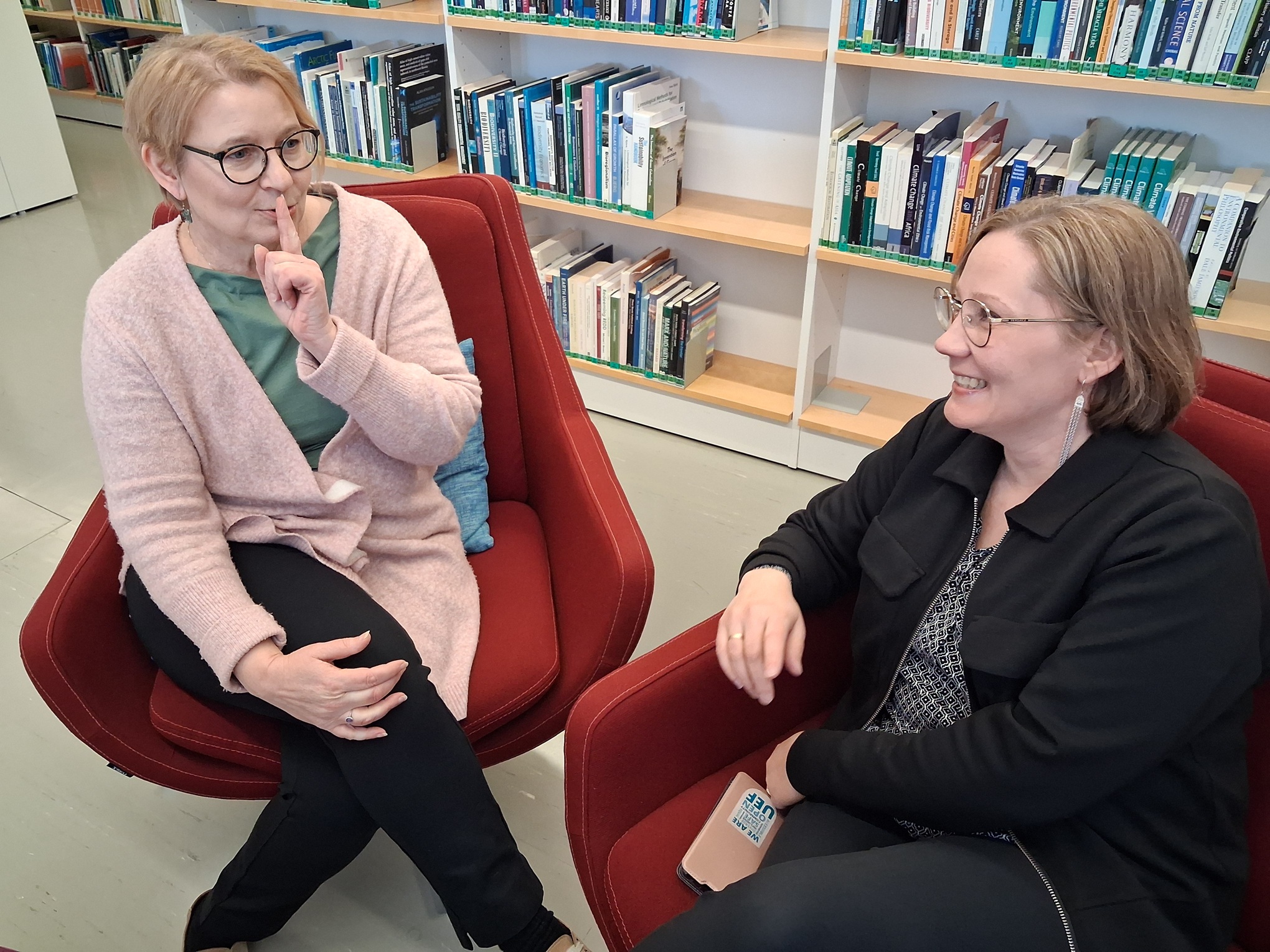
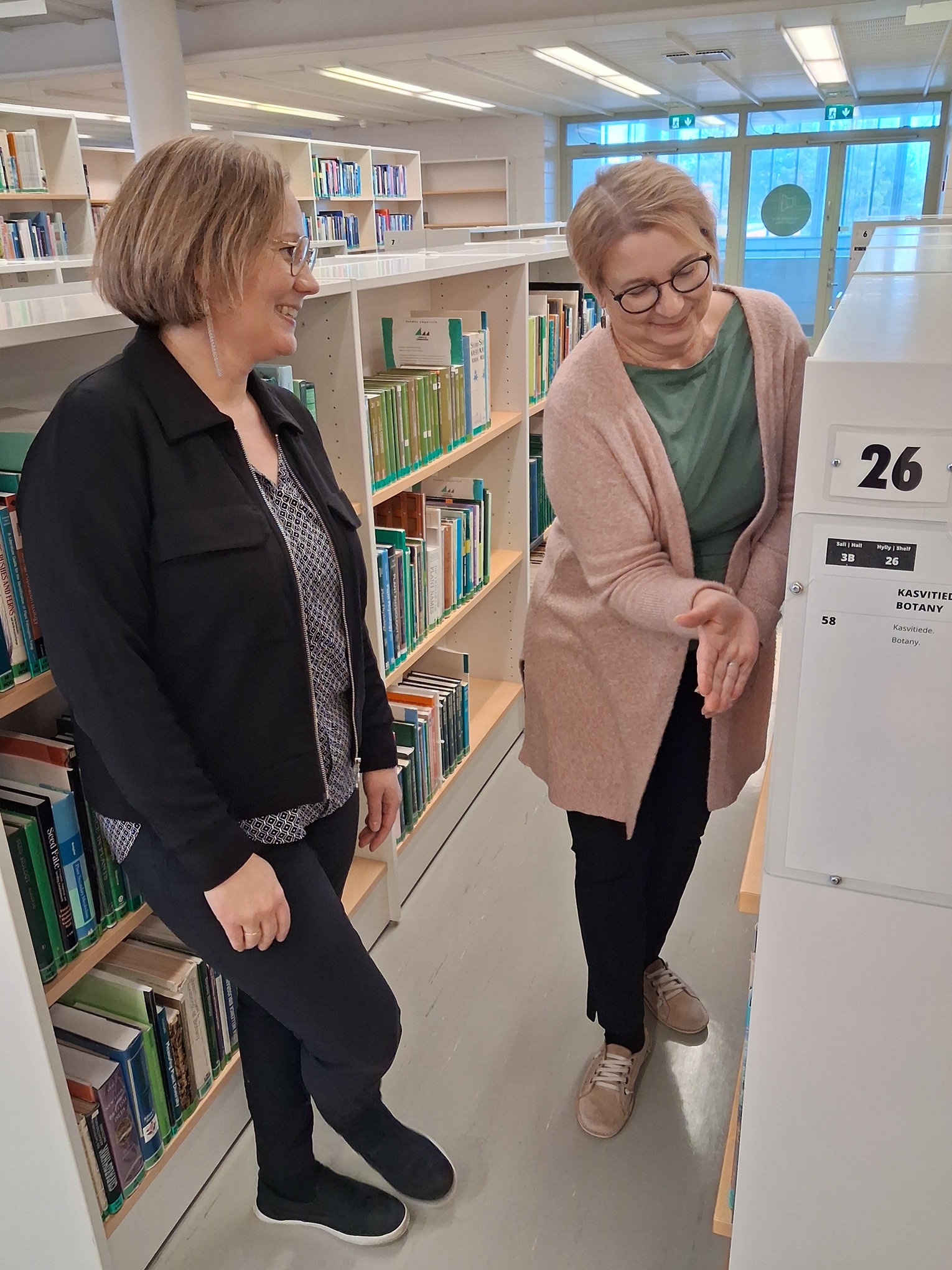
A generational change has taken place in the leadership of the Collection services of the University of Eastern Finland Library. The long-serving Head of Services, Riitta Porkka, has gone on leave and will move smoothly from leave into retirement. Katja Hyvärinen, who took up the role of Head of Services last year, has now assumed the position. The field of responsibility is not new to Katja, as she has worked in collection-related roles at the library for over a decade.
In the following, Katja and Riitta discuss the past, present, and future of information resources work at the library, based on questions posed by the Library Director, Irene Ylönen.
Then and now
When you started your career, what did information resources work look like in everyday practice?
Riitta: Everyday work revolved around printed materials and manual processes. Practically everything was done by hand, and everything moved a bit more slowly. Examples are countless. For instance, new journal issues were checked in one by one in cardboard card files. In acquisitions, purchase requests were sent as letters to publishers or vendors. There were bookshelves everywhere, filled with printed materials waiting to move on to the next stage of the workflow.
Shelving returned books also took up a significant portion of several employees’ daily working time. Books circulated constantly, and resources were needed for repairs and other maintenance. One of my first tasks was to walk through all the library halls every day and use a marker pen to add new markings to worn location labels on books. That task stuck in my mind — it was probably the very first assignment I had on my own.
Cataloguing was no longer done on cardboard catalog cards, but the records of the library’s collections were transferred onto microfiches. These fiches served as the library catalogue, and information retrieval was carried out mainly using the microfiches.
Which tasks or processes have disappeared completely?
Riitta: I’m not entirely sure that any work has ultimately disappeared altogether. The work has changed from being manual to being computer-based. The focus of how working time is spent has shifted. Overall, everything has become faster — for example, electronic journals no longer need to be manually checked in to the system; with a single click, users can always access the latest issue. Acquiring and making materials available to users often takes only minutes today. In the past, one had to allow for acquisition processes that could take weeks.
On the other hand, unfortunately not everything online works simply at the push of a button, and various kinds of investigative and problem-solving work have emerged to replace tasks as other processes have become more streamlined.
Which change felt the most significant at the time — the shift to electronic resources, licensing, changes in metadata work, or something else?
Riitta: The transition to electronic resources has certainly been the most significant change during my career. It affects virtually every aspect of library work. At the same time, I also think that the fundamental goals of the work have remained the same. Only the processes and the ways of working toward those goals have changed.
How have open science and open publishing changed information resource work?
Katja: Open Access resources, that is, openly available online materials, have increased significantly over the past roughly ten years. Information resource work is made easier by the fact that, for example, license and copyright statements as well as the use of persistent identifiers in online materials have become established practices. It is easy to add and describe open materials in the library’s database, but of course we do not include everything that is published openly on the web. In terms of open materials, information resource work is very similar to other electronic resource work, with the exception that the actual acquisition process is omitted.
How do you see library information resource work today – what is its core?
Katja: The core is still very much about ensuring that we acquire and describe in the library database material that serves the research carried out at our university and benefits our users. Priority is given to university staff and students, but our library is open to everyone.
Which tasks are now the most critical that did not exist at all fifteen years ago?
Katja: In recent years, the library’s role in supporting researchers has grown, and the library has strengthened its position as an expert organization in open science. In information resource work, generative artificial intelligence has introduced tools that simply did not exist fifteen years ago – when I myself joined the organization.
What do you see as essential to information resource work in a modern academic library?
Katja: Perhaps interaction at both the individual and the organizational level. In addition, I believe that resource acquisition should be based on need and usage. Printed collections are no longer built up through donations as heavily as they were in previous decades.
Has the library become more of a service organization than a collection-driven organization?
Katja: I would say that the library is a service organization that thinks about and develops its collections.
Competence and expertise
How have competence requirements changed?
Riitta: Nowadays, there is clearly a need for development-oriented and renewal-minded work. It is no longer sufficient to simply master and be good at the core tasks of your own job description. An understanding of the bigger picture and a readiness for change are required. Work processes and requirements are constantly evolving, and overall, the participation and expertise of all library staff are needed in development work.
Katja: I would add to Riitta’s thoughts that in the past, a degree in library and information science was practically a requirement in all job advertisements. Nowadays, it makes sense for job postings to place more emphasis on the kind of relevant skills and expertise being sought. That said, studies in library and information science still play an important role in managing and developing library work.
Has the identity of the information resources professional changed – and if so, how?
Riitta: I’m not sure whether the identity itself has changed, but – perhaps also referring to my earlier comment – information resource work now more comprehensively includes a service and collaboration dimension.
What skills are absolutely essential for future information resource work?
Katja: More than ready-made expertise, I would emphasize the ability to collaborate and a willingness to learn new things. In information resource work, there will of course continue to be value in understanding the history of collection development and cataloguing, but the ability to think “outside the box” is also needed.
What traditional skills should not be lost, even as the operating environment changes?
Riitta: An understanding of the importance of metadata and an interest in the content of the library’s information resources.
Leadership in a changing information resource landscape
What was the most difficult part of leadership when the transition to e-resources began to take shape?
Riitta: Ensuring staff competence and opportunities for training was crucial. Likewise, coping with constant change – how to maintain work motivation and well-being in an environment of continuous transformation.
How did the staff respond to the change?
Riitta: It must be said that we have had a motivated staff with a positive attitude toward renewal. We have also been actively involved in national development work, which naturally brings positive input back into the organization as well. That said, over the years there have also been challenges: changes in job descriptions and the reduction of certain individual tasks have appeared as some degree of uncertainty in the face of change, and also as sadness over the feeling that one’s work may no longer matter.
How do you lead competence in an environment where technology and customer needs are constantly changing?
Katja: My first thought is by listening and engaging in dialogue. It is easier to operate in a changing environment if we are able to discuss opportunities and concerns early on.
How can a sense of meaningfulness be maintained when familiar work begins to change or even disappear?
Katja: First of all, everyone’s work is important and meaningful, even when it doesn’t always feel that way – sometimes demonstrating this requires a shift in perspective. If it feels like one’s work is changing too much, disappearing, or not being valued, that feeling should not be avoided but rather brought up for discussion. Most often, through conversation, another perspective is found that helps rekindle motivation and enthusiasm for the work.
In conclusion
What will you miss the most?
Riitta: The work community and the people, without a doubt—that is number one. And also the work itself, which I have remained motivated by for more than thirty years. It has been wonderful to work together on something that has felt meaningful.
If you could give one piece of advice to your successor, what would it be?
Riitta: Take care of well-being—your own and that of your employees. Make time to pause; everything cannot be done immediately. Allow space to focus on what is important and sustainable in the long run.
What excites you in this work right now?
Katja: The people. There is an excellent and truly highly competent team working in Collection services and throughout the entire library. I feel very privileged to be able to lead this service.
What will information resource work look like in ten years’ time?
Katja: In the library, information resource work will be carried out according to principles that stand the test of time: collections will be evaluated and renewed, and metadata will be systematically stored in the library system. It is difficult to imagine that this kind of core work related to collections would be abandoned as long as the library exists. Instead, working methods and tools will certainly continue to change and develop.
What lesson do you take with you from your predecessor?
Katja: From time to time, it is good to try to look at things from a bit further away and as part of a larger whole.
Edited by Mikko Meriläinen, information specialist
Collection services