
Citing
The scientific work requires knowledge and a connection to former research. So utilising other people’s work is not only admissible but essential. Still, the author of an article, chart, picture or invention always has a copyright to his/her work and must be mentioned and credited in a proper way. This is called citing.
Citing is crediting
The citing is done in a very formal way. This has two purposes.
- To separate the other people’s ideas from your own thinking (=citing within the text).
- To give sufficient information about the publications used, so that everyone can locate the original paper (=the bibliography or reference list of publications mentioned in a text).
What is the difference between citing and plagiarism?
Plagiarism =”The action or practice of taking someone else’s work, idea, etc., and passing it off as one’s own; literary theft.” (In Oxford English dictionary. Retrieved March 6, 2026, from https://doi.org/10.1093/OED/2684628460.)
Plagiarism takes place when a writer fails to indicate the source from which information, an idea, or an explanation actually originates. By contrast, citing sources shows which earlier theories, methods, and findings the writer is aware of, and how they relate their own results to the interpretations of others. Citing is an essential part of academic research. Also thesis must follow these general rules.
A referencing means expressing another person’s idea in one’s own words. This is the recommended practice in academic writing.
A quotation means a direct copy, word for word, from someone else’s text.
A quotation must be clearly marked, for example with quotation marks (for a short piece of text ) or indentation (for paragraphs). Direct quotations should be used only when it is necessary to present the content exactly as it appears in the original text. Quotations should be kept as brief as possible.
See a video by David Taylor (3:13):
In Finland, the Copyright Act (1961/404) (link opens in a new tab) and the related decree regulate the use of publications (published works) in general. Electronic materials are also protected by copyright law. There is no difference if a material can be accessed freely or by payment.
Citing requires the metadata
The citation always has some permanent key elements that must be included in the reference list (i.e. bibliography).
The references in databases contain the same elements of identifying and locating the publications: Author, year, title, journal name etc. = Metadata
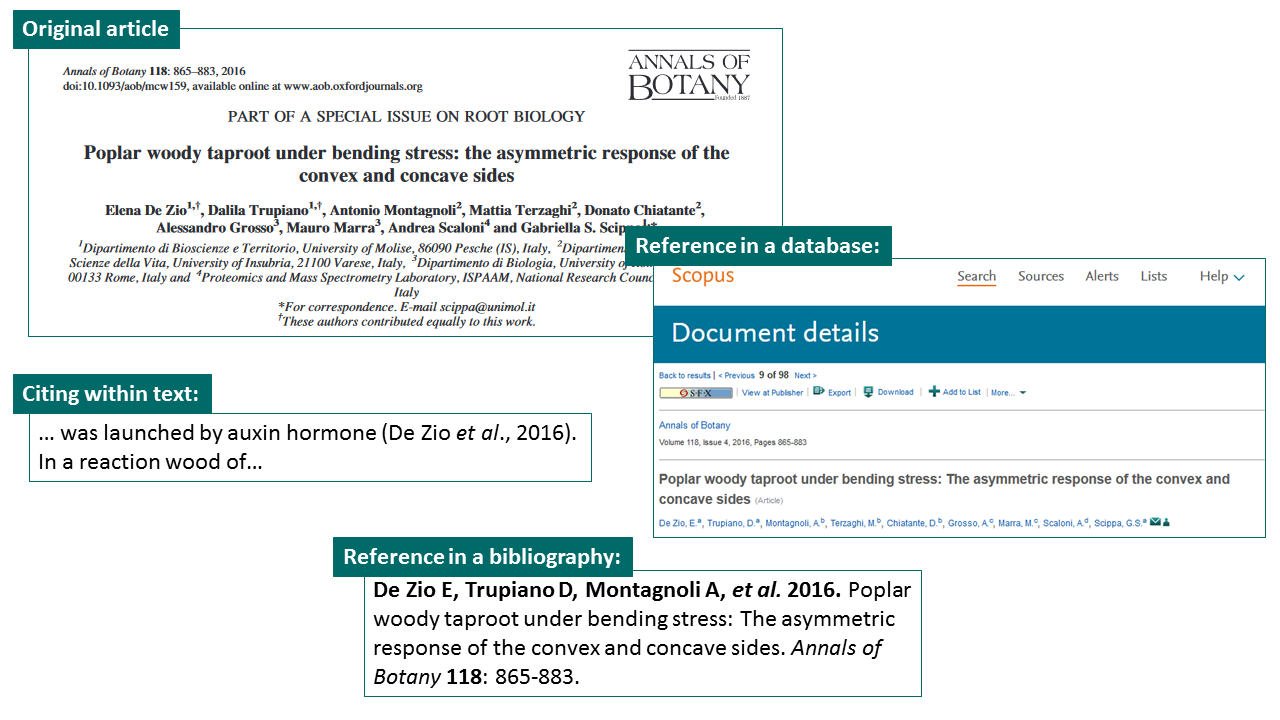
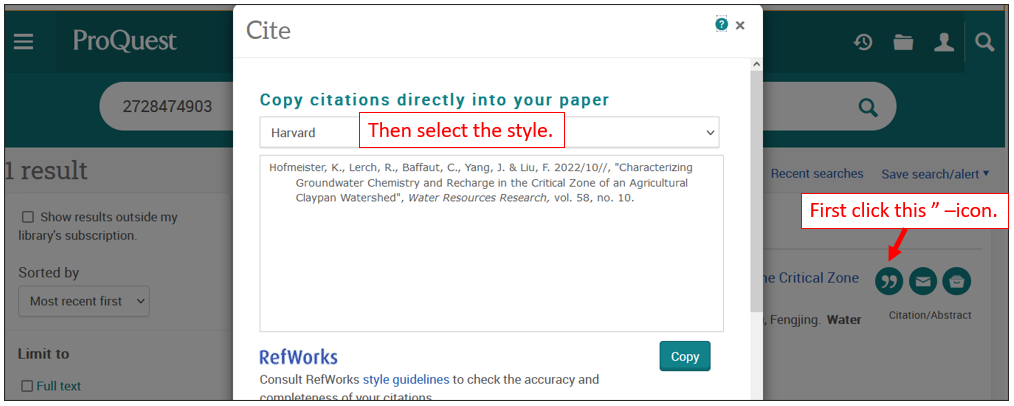
TIP: Many databases (e.g. Scopus, ProQuest, UEF Primo) provide a tool for formulating a ready-made citation for a reference list. It might be called “Cite” or “Create bibliography”.
There are different citation styles available among you can choose, like Harvard or Chicago:
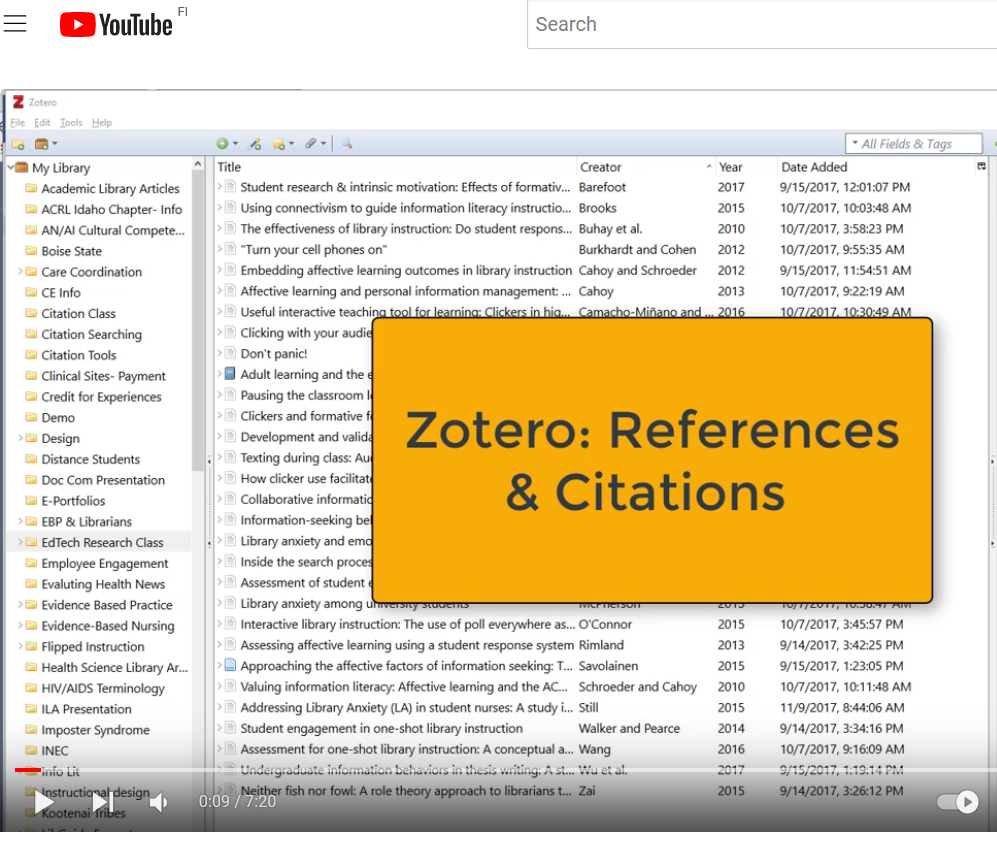
Also, a reference management program can be used as a tool for citing, even for within-text citations. See a video (7:20) by Idaho State University Library, how this is done in Zotero program:
Database Usage Rights
In addition to copyright, the use of materials is regulated by the rights of publishers and content providers. These rights relate to the purpose of use, storing, and further distribution of the materials.
Use of Online Resources
The use of electronic publications acquired by the library (e‑books, e‑journals, reference works, dictionaries) as well as databases is governed by specific licence agreements.
What is allowed?
- to use materials for study and research
- to print or save a reasonable amount of search results and articles
- to print or save parts of e‑books
- to send individual document files to a colleague for their own research use, in the spirit of “scholarly communication”
- to create a link to an article, e‑book, etc., in a learning environment or on a website
What is not allowed?
- to use the materials for commercial purposes
- to systematically download large amounts of search results
- to download or print an entire e‑book
- to distribute the materials to persons who are not authorised users
- to upload the original article (e.g., PDF) or similar electronic resources to a learning environment or website
To Do:
- Clearly indicate which ideas in your text are someone else’s.
- Compile the references list according the rules and style given. You can use some ready-made tools for that.
This is the last page. Return to home page.