
Language carries culture also in research
The language guidelines of the SusTra doctoral pilot takes into account domestic languages.
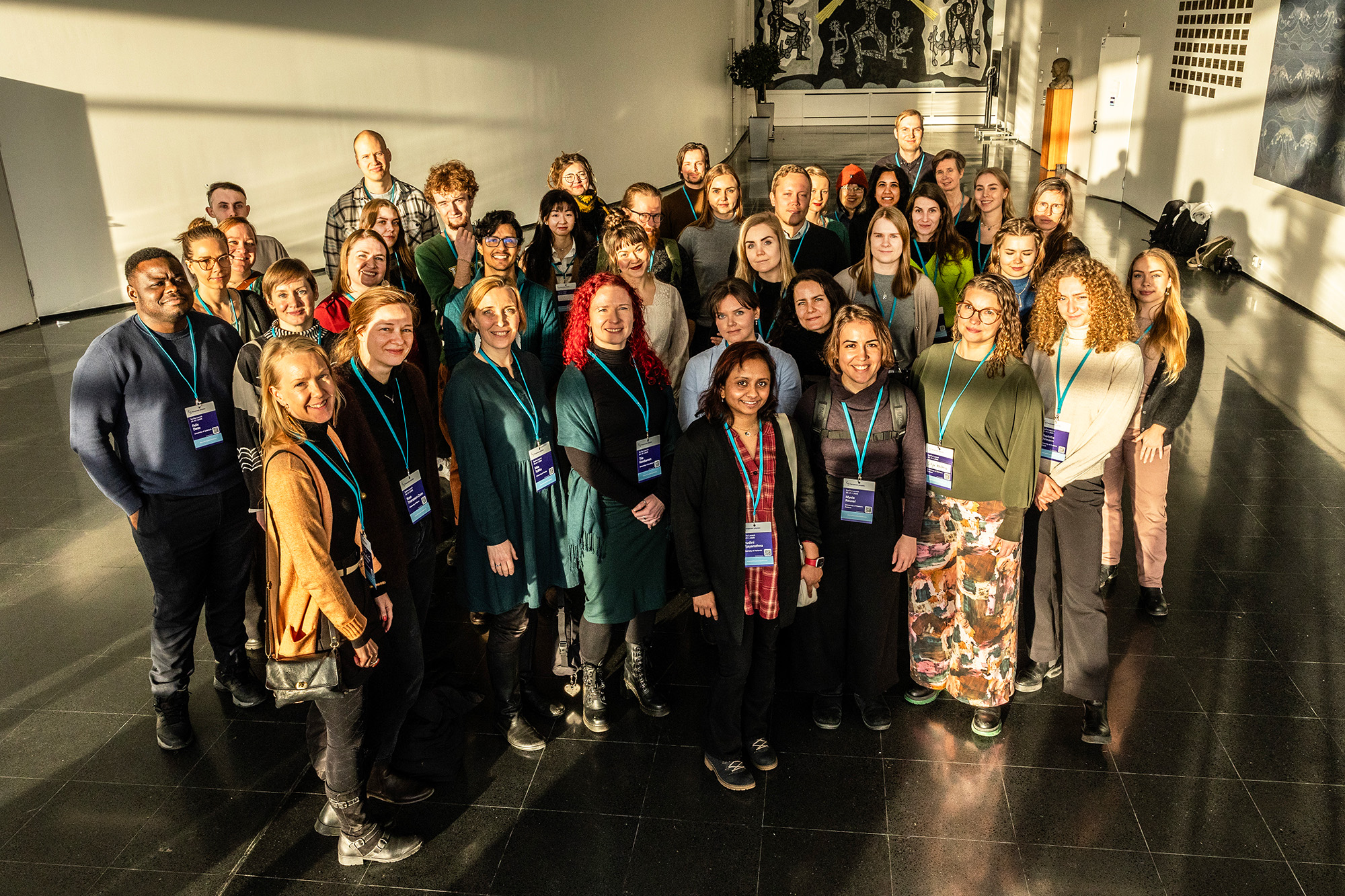
Doctoral researchers of the SusTra doctoral pilot from 10 Finnish universities represent many different scientific fields. Photo: Jonne Renvall
Universities often speak the language of internationalisation. English dominates websites, research publishing, recruitment campaigns, and conference stages. Yet beneath this seemingly practical choice lies a deeper question: do domestic languages still have a role, and what kind of academic communities are universities creating through their language policies?
The recently approved language guidelines of the Sustainability Transformations doctoral pilot SusTra in Finland offer a thoughtful response to this question. The guidelines promote the parallel and deliberate use of domestic languages alongside English. Rather than treating language merely as a technical tool for communication, the guidelines approach language as a cultural, social, and epistemic issue. This distinction matters greatly at a time when universities are becoming increasingly global while simultaneously being asked to strengthen their societal relevance and local impact.
The SusTra guidelines begin with a simple but powerful idea: language carries culture. Just as biodiversity strengthens ecosystems, linguistic diversity enriches intellectual and cultural life. Universities, especially those working on sustainability transformations, should understand this instinctively. Sustainability challenges are complex, contextual, and deeply intertwined with society. They cannot be solved through one worldview, one disciplinary framework, or one language alone.
Language shapes possibilities for participation
Across Europe and beyond, universities have increasingly shifted toward English-only environments. The reasons are understandable. English is the dominant language of international science, publishing, rankings, and academic mobility. A shared language lowers barriers for international collaboration and creates access to global scholarly conversations. However, the unintended consequences are now becoming more visible.
When universities move entirely into English, they risk weakening their connection to local societies. Scientific knowledge may circulate globally while becoming less accessible nationally. Researchers may publish internationally but struggle to communicate findings to policymakers, civil servants, schools, businesses, or citizens in their own countries. In small-language nations such as Nordic or Baltic countries, this tension is particularly acute. If universities gradually abandon domestic scientific discourse, entire vocabularies for discussing sustainability, technology, democracy, or health in national languages may erode.
This is not merely symbolic. Language shapes participation. A university that functions only in English implicitly privileges some groups while marginalising others. International researchers may feel included academically but excluded socially if opportunities to learn local languages are weak. Domestic stakeholders may feel disconnected from research communities that increasingly operate in inaccessible terminology. Meanwhile, multilingual scholars often carry invisible burdens, constantly navigating between different linguistic and cultural worlds.
The SusTra language guidelines avoid simplistic either-or thinking. It recognises that English is essential in research collaboration, but it simultaneously emphasises the importance of maintaining Finnish scientific terminology and discourse. The guidelines also acknowledge the value of Swedish, and all Sámi languages, thereby connecting language policy to broader questions of cultural diversity and inclusion. Importantly, the document frames multilingualism not as a problem to manage, but as a resource to cultivate. This perspective deserves wider attention in higher education.
Too often, university language policies remain vague, reactive, or purely administrative. Institutions frequently declare themselves “international” without carefully considering what linguistic inclusion requires in everyday academic life. True multilingualism is not achieved by translating a strategy document into English. It requires structural commitment.
On supporting linguistic diversity in universities
Universities should design language policies around participation rather than efficiency alone. Meetings, seminars, and events should openly discuss language expectations in advance. Hybrid linguistic practices – where multiple languages coexist flexibly – should become more accepted instead of being viewed as inconvenient exceptions.
Secondly, universities should invest seriously in language learning. International scholars should have meaningful opportunities to learn local languages during working hours, not merely through optional evening courses. Equally, domestic staff should receive support for improving their academic English and intercultural communication skills. Multilingual competence should be recognised as academic labor rather than treated as an invisible personal responsibility.
Thirdly, universities should reconsider how societal impact is evaluated. If institutions genuinely value engagement with society, communication in domestic languages must count in recruitment, promotion, and funding decisions. Public scholarship, policy engagement, and national scientific discourse require linguistic accessibility.
Languages as part of the sustainability transformation
Universities should understand language policy as part of sustainability itself. Sustainability transformations demand dialogue across sectors, communities, and cultures. Monolingual systems may appear efficient, but they can also narrow perspectives and reduce intellectual resilience. Diverse linguistic environments, by contrast, strengthen the ability to understand different perspectives, critically reflect on one’s own thinking, and imagine alternative futures.
Universities shape not only knowledge, but also languages through which societies imagine their futures. That responsibility should not be underestimated.
The authors are part of the Sustainability Transformations doctoral pilot SusTra 2024-2027. Direct link to the SusTra language guidelines is available here.
Authors
Leena Aarikka-Stenroos, Professor of Industrial Engineering and Management, Tampere University
Minna Halme, Professor of Sustainability Management, Aalto University School of Business
Meri Löyttyniemi, Research manager of SusTra, University of Eastern Finland
Arto O. Salonen, Professor, Director of SusTra, University of Eastern Finland