Supporting the Well-being of Children and Families
It has been a privilege for me to engage in long-term research collaboration with Professor Emeritus Juha Hämäläinen (Juha Hämäläinen – UEFConnect) and Professor Riitta Vornanen (Riitta Vornanen – UEFConnect) on themes that are both academically and societally significant: children’s and families’ well-being and sustainable development. Our collaboration has been based on a shared interest in examining well-being from a broad perspective — not merely as a matter of service systems, but as an integral component of a socially and morally sustainable society.
Our joint research has resulted in several co-authored publications, includingParents’ Views on Family Resiliency in Sustainable Remote Schooling during the COVID-19 Outbreak in Finland and Sustainable Family Life and Child Welfare: A Conceptual Framework. In particular, emergency remote schooling during the COVID-19 pandemic provided a unique research context in which families’ everyday resilience, support structures, and risks of inequality became visible in new and revealing ways.
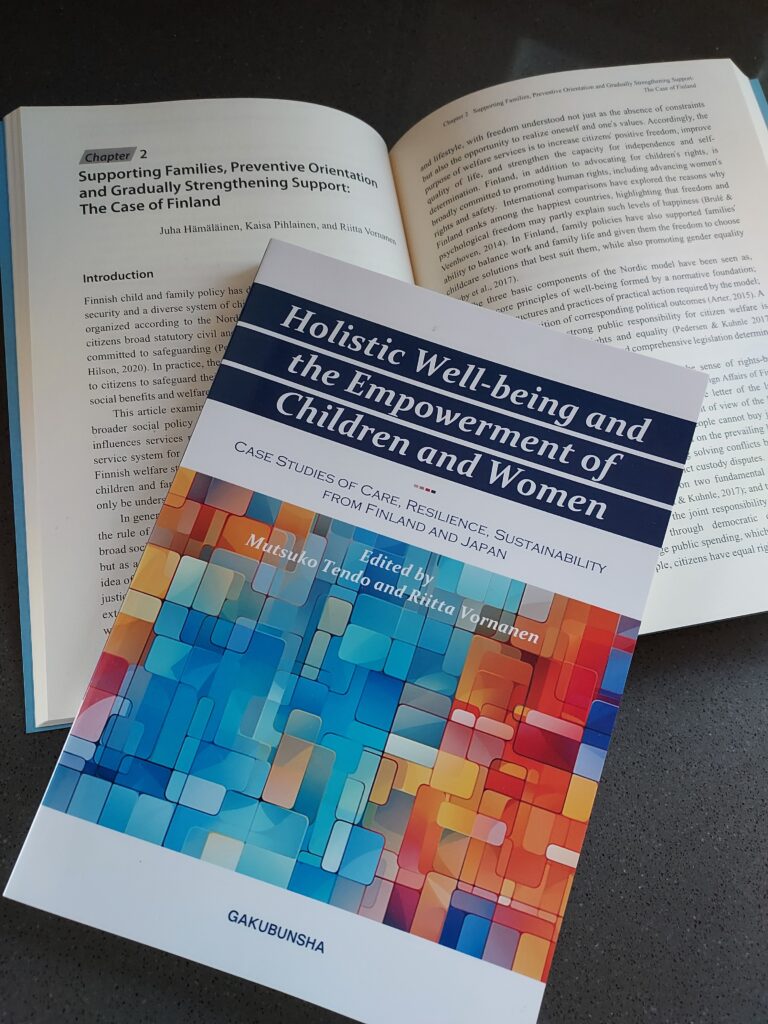
We continued this collaboration by co-authoring a book chapter for the volume edited by Mutsuko Tendo and Riitta Vornanen, Holistic Well-being and the Empowerment of Children and Women – Case Studies of Care, Resilience, Sustainability from Finland and Japan. In this chapter, we analyse the principles underpinning the support of children’s and families’ well-being in Finland and examine how these principles are connected to the goal of sustainability.
Our analysis is grounded in Finland’s position as a Nordic welfare state and in key normative foundations, particularly children’s rights and the primacy of the best interests of the child. Based on these principles, the Finnish family service system has been built around preventative support and progressively intensified assistance according to need. In my research, I have been especially interested in how these policy aspirations are realised in practice, and in identifying the points at which the system’s resilience is put to the test.
In the chapter, we critically examine what sustainability means within the family services system, the structural and professional tensions associated with it, and how support can be targeted in ways that ensure that children, young people, and families in vulnerable situations do not become invisible. I consider supporting these groups to be essential for safeguarding children’s participation, well-being, and equal conditions for growth.
Based on our research, we argue that promoting the well-being of children and families requires continuous evaluation and development of both the service system and professional practices. This is not merely an administrative or economic issue, but part of a broader commitment to strengthening a socially and morally sustainable society for future generations.
Kaisa Pihlainen
Reference: Hämäläinen, J., Pihlainen, K., & Vornanen, R. (2026). Supporting families – preventive orientation and gradually strengthening support. The case of Finland. Teoksessa M. Tendo & R. Vornanen (Toim.), Holistic well-being and empowerment of children and women – Case studies of care, resilience, sustainability from Finland and Japan. Gakubunsha Co., 40–59.