
How can interprofessional interaction be learned through simulation?

Interaction and collaboration are often considered key solutions in social and health care reforms to streamline service processes and improve efficiency. Paradoxically, however, constant and sudden reforms may undermine previously functional structures, which can weaken the support received by clients or cause work to revert to fragmented and overlapping practices (cf. Mönkkönen & Kekoni 2020; Timperi 2025). In everyday practice, collaboration does not arise automatically: discussions easily proceed at cross-purposes or shared understanding fails to develop. We have explored these issues through interprofessional learning implemented in a multidisciplinary manner.
In this article, we examine interprofessional learning and describe how it can be taught through drama- and simulation-based pedagogy. Interprofessional learning refers to students from different fields learning together – from each other and about each other (WHO 2010) – which strengthens their capacity to work collaboratively in demanding situations.
Drama-based simulation teaching is well suited to both small and large groups, in on-site or remote formats, and offers an effective method for practicing work in challenging client situations as well as interprofessional collaboration.
Foundations of interprofessional education
Professional education has traditionally focused on discipline-specific expertise and individual competencies, even though developing shared interactional competence better meets the current demands of working life (see Horila & Valo 2016). Learning together also supports the development of an interprofessional identity, which is constructed through experiences of significance and belonging within an interprofessional group (Reinders et al. 2025; Miettinen et al. 2025).
At the University of Eastern Finland, the development of interprofessional simulation-based learning began in 2015, first in the form of large-scale simulations and later as annually recurring small-group simulations addressing demanding interprofessional crisis situations such as sudden infant death (SIDS). The simulations were created in extensive collaboration with a paramedic educator from Savonia University of Applied Sciences, a hospital chaplain, a social emergency worker, the police, and professional actors. Since then, large-scale interprofessional simulations have been arranged annually with various university disciplines, universities of applied sciences, and vocational institutions. Some of the recordings from these large simulations have also been developed into international learning materials and incorporated into ongoing teaching. The pedagogical value of resource-intensive simulations increases significantly when they are transformed into reusable learning materials. Through simulation teaching, teachers’ roles have expanded to include producing large educational events, scriptwriting, set design, and close collaboration with both professionals and performing artists. Multidisciplinary teaching teams have also studied interprofessional learning (Saaranen et al. 2020; Äikäs et al. 2020; Mönkkönen et al. 2022; Karkkola et al. 2023; Kekoni et al. 2024; Jaakkola et al. 2025; Miettinen et al. 2025).
The first course on interprofessional interaction created in 2015 gradually expanded into a five-credit course titled Interprofessional Competence, which has become a permanent part of the curricula in five disciplines (social work, special education, psychology, social psychology and speech and language therapy). The course includes a MOOC produced jointly with the University of Turku, a group assignment conducted in multidisciplinary teams, and simulation-based learning held on both the Kuopio and Joensuu campuses.
The University of Eastern Finland has thus been a pioneer in developing interprofessional learning, made possible through managerial support, joint planning, and the alignment of curricula and conceptual frameworks. We have also participated in designing a Smart Simulab learning space suitable for small-group simulations, where intelligent recording and monitoring technology supports learning.
What is drama-based simulation learning?
Simulation teaching creates, in the literal sense, a simulated situation that mirrors a real client scenario as closely as possible. Scripts are usually developed in multidisciplinary teaching teams to ensure balanced representation of different professional perspectives. Our small-group simulations are drama-based, differing from traditional health sciences simulation teaching in which students are often expected to present their “best professional selves” (Tervaskanto-Mäentausta 2018; Saaranen et al. 2020). In drama-based simulation, which is grounded in drama education, students are instead invited to adopt a role through which they participate in constructing shared understanding and making decisions about the client’s situation. The role may be a professional role or the role of the client or a family member, and the student embodies it based on cues provided in the script.

The exercise is not aimed at perfect performance, nor do we speak of acting. Rather, the imperfection of the situation and the safe willingness to immerse oneself in the role support shared learning. The learning objectives focus on decision-making, collaboration, and communication, and on understanding and analyzing these dimensions.
Preparation Phase
Simulation learning begins with preparing the drama script, and realistic case examples are drawn from client encounters experienced by teachers from different disciplines. Small-group simulations have addressed situations involving an elementary school child with special support needs and their family, as well as a vocational education student who raises professional concern.
Students receive the cases, role descriptions, and an explanation of the nature and structure of drama-based simulation in advance. Because the scenarios may be sensitive and participation may evoke anxiety, students are given the opportunity to discuss concerns with a teacher beforehand to ensure a sense of safety.
Drama-based small-group simulations require two separate instructional spaces, and the furniture is arranged to support interaction in an interprofessional meeting. At the back of the Smart Simulab space is a control room where teachers can monitor the exercise in real time via screens and manage the timing of the scenario, such as its beginning and end. The space includes integrated cameras and recording capabilities so that the simulation can be reviewed in the learning discussion. Smart Simulab also supports live streaming, allowing observers to follow the drama from another room.
Structure of the simulation exercise
A small-group simulation proceeds in three stages: orientation, enacted drama, and learning discussion. The simulations we implement take place over two days. On the first day, the same scenario is simulated twice, with a learning discussion held between the two simulations. On the second day, a new case is addressed, also enacted twice. In the latter simulation, the fictional interprofessional team meets again two weeks later. The complexity increases because a school counsellor has received information about the young person that the others do not yet know. This supports essential discussion about confidentiality and interventions and provides opportunities to practice sensitive communication. Figure 1 illustrates the structure of the small-group simulation exercise. Participants include the teaching team, a small group of up to sixteen students, a teaching assistant providing technical support, and a professional actor. Below, we describe each phase of the simulation in more detail.
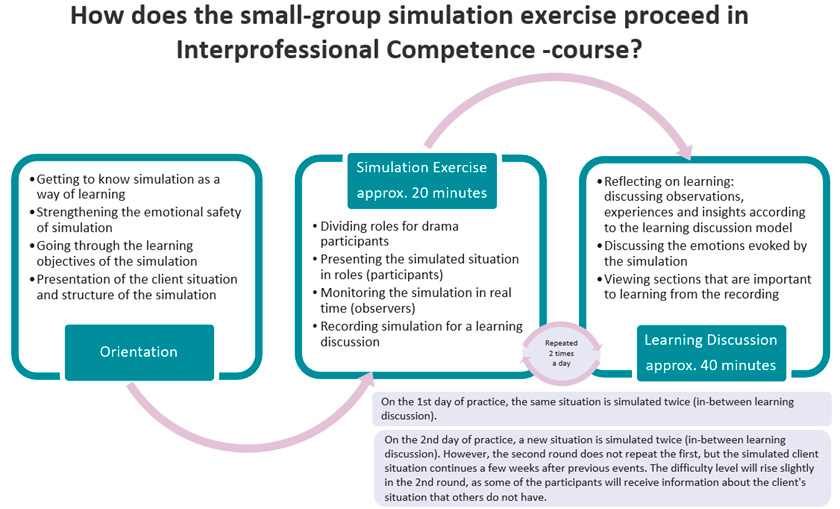
Figure 1. The structure of the small-group simulation exercise in Interprofessional Competence -course.
Orientation
All participants gather in the same room to begin the session. The emotional safety of the learning environment is reinforced through introductions and by giving each participant the opportunity to express their initial feelings and assumptions. The schedule allows sufficient time (approximately 45 minutes) for a calm start. One of the teachers reads the case aloud, after which roles are assigned. Role descriptions contain various character types—such as “experienced professional”, “busy performer”, and “supportive listener”—to bring realism and the texture of everyday life, where individuals’ differing ways of perceiving situations influence interaction. Role descriptions serve as prompts, but students are free to immerse themselves and improvise. The exercise does not focus on discipline-specific content (e.g., service systems or legislation) but specifically on shared interaction. Each student is given at least one opportunity to participate in the simulated client situation.
Simulation exercise
The drama component of the simulation lasts approximately 20 minutes. Students assigned to roles work with the professional actor in the simulation space, while observing students follow the situation via live stream from another room. The simulated event is an interprofessional meeting where professionals from different fields discuss the situation together with the client and/or their family members.
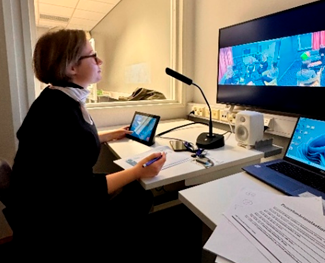
Teachers and the teaching assistant monitor the exercise from the control room, where they see and hear the scenario through monitors. At least one teacher or the teaching assistant is present with the observing students, while the teachers in the control room provide guidance to students participating in the simulation. During the drama, teachers take notes on observations relevant to learning, such as how the situation began, developed, and ended; the client’s position in the interaction; and how the professionals related to the client and to one another. After the simulation, de-roling is essential to help students detach from the intense situation and view it from a distance.
Learning discussion
The learning discussion that follows the simulation provides space for reflection, shared analysis of observations, experiences, and emotional responses. The exercises and discussions are confidential. The discussion always begins with the perspectives of those who participated in the drama. Feedback must be respectful, highlighting strengths and successful choices first. Video excerpts from the simulation are reviewed; students often make their sharpest observations only when watching themselves and others on video.
The teacher ensures that all participants are heard and validates the emotions expressed. The teacher may also introduce issues not raised by students. It is important to link the discussion to research on the topic and to help students situate their discipline-specific knowledge in relation to other fields’ knowledge and core tasks.
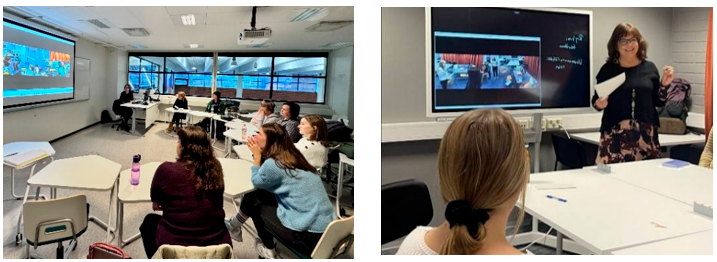
Figure 2 illustrates the learning discussion in an interprofessional small-group simulation. It is important to note that each teacher can tailor the discussion based on their experience and the specific simulation, but the structure in Figure 2 can serve as a support, framework, or stimulus for discussion.
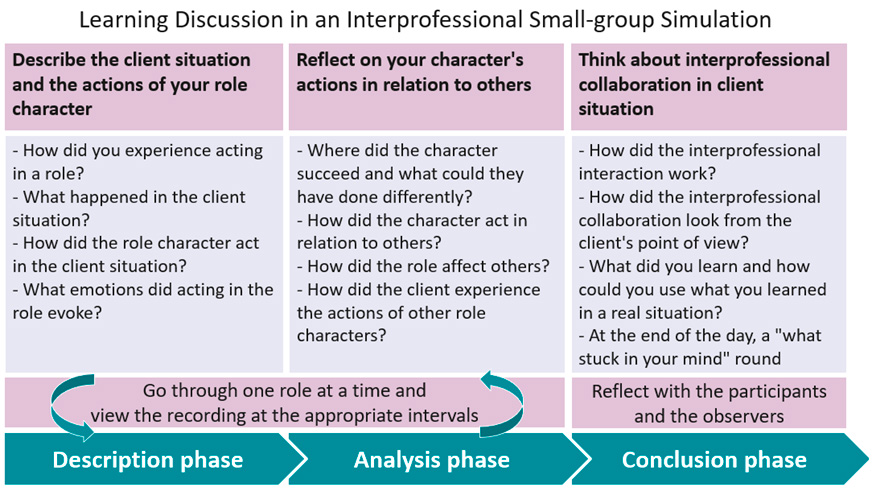
Figure 2. Learning discussion in an interprofessional small-group simulation.
Pedagogical insights
Each simulation-based learning session has deepened our understanding of human encounters and interprofessional collaboration. The working method is facilitative: students’ knowledge and experience are central, and the exercises emphasize sensitivity, voluntariness, and autonomy. Simulation offers a safe environment for testing one’s limits and immersing oneself in a role, allowing participants to observe their own actions from a distance and with greater objectivity. Physical spaces support learning by separating performance and observation. Learning discussions serve as bridges to subsequent exercises, enabling students to develop their practice. This reflective process—reframing one’s actions and connecting the simulated situation to real professional practices—forms the core of drama-based simulation learning (cf. Heikkinen 2002). For this reason, teamwork among the teaching team, clear roles and responsibilities, and readiness to address difficult topics are essential.
Developing interaction skills is not only an educational matter; improving work practices also requires rehearsal as part of professional routines. Research has shown that the professional–client relationship is central to the effectiveness of interventions (e.g. Wampold & Flückiger 2023). We have also conducted simulation exercises with experienced professionals, who often identify similar challenges in interaction and collaboration as students do. In spring 2025, simulation learning was used in the FITFUTURA project (FITFUTURA – Strengthening collaborative child protection processes through feedback-informed treatment), where practitioners rehearsed the Feedback-Informed Treatment (FIT) approach. Participants included social workers, family workers, teachers, and experts by experience acting in the client role. Although methodological expertise is often context-specific, our findings on the importance of dialogue skills, collaborative competence, and managing the conversation process reflect broader generic skills in client work and interprofessional collaboration (Timperi et al. 2026). Therefore, simulation learning provides an impactful tool for developing interaction and collaboration skills in working life.
Sources
Heikkinen, Hannu (2002). Draaman maailmat oppimisalueina: draamakasvatuksen vakava leikillisyys. Jyväskylä Studies in Education, Psychology and Social Research 201. Jyväskylä: Jyväskylän yliopisto. https://urn.fi/URN:ISBN:978-951-39-4006-5
Horila, Tessa & Valo, Maarit (2016). Yhteinen vuorovaikutusosaaminen tiimissä. Prologi: puheviestinnän vuosikirja 2016, 46–58. https://doi.org/10.33352/prlg.95912
Hyvärinen, M. L., Pakarinen, E., & Kekoni, T. (2024). Online simulations as a tool of integrative pedagogy in learning social work practice skills. Social Work Education, 43(9), 2914–2932. https://doi.org/10.1080/02615479.2023.2299264 Full article: Online simulations as a tool of integrative pedagogy in learning social work practice skills
Jaakkola, Jenni, Mönkkönen, Kaarina, Kekoni, Taru & Hyvärinen, Marja-Leena (2025). Multimodaaliset keinot ammattien välisen vuorovaikutuksen rakentamisessa. Sosiaalilääketieteellinen Aikakauslehti, 62(3), 578–597.
https://doi-org.ezproxy.uef.fi:2443/10.23990/sa.144712
Jokinen, Arja (2022). Neuvonanto ja kasvotyö sosiaalityön vuorovaikutusharjoitusten vertaispalautteessa. Janus: sosiaalipolitiikan ja sosiaalityön tutkimuksen aikakauslehti 30:3, 215–231. https://doi.org/10.30668/janus.109215
Karkkola, Petri, Äikäs, Aino, Kasanen, Kati, Issakainen, Mervi, Kekoni, Taru & Mönkkönen, Kaarina (2023). Student Perceptions of Interprofessional Education: Associations with the Major Subject, Previous Education and Work Experience. International Journal of Research in Education and Science (IJRES), 9(4), 878–890. https://doi.org/10.46328/ijres.3278
Kekoni, Taru, Mönkkönen, Kaarina, Hyvärinen, Marja-Leena & Pakarinen, Eine (2024). Vuorovaikutus työelämässä: Kuinka edistää yhteistyötaitoja. Helsinki: Gaudeamus.
Miettinen, Anna, Kekoni, Taru & Mönkkönen, Kaarina (2025). Monialaisen identiteetin rakentuminen oppimisessa. Teoksessa Ritala-Koskinen, Aino, Räsänen, Jenni-Mari & Salo, Arttu (toim.) Sosiaalityö ja sote-integraatio. Tampere: Tampere University Press, 261–287. https://doi.org/10.61201/tup.961.c1742
Mönkkönen, Kaarina, Koponen, Jonna, Kekoni, Taru, Kallinen, Kati & Salmi, Anne (2022). Pienryhmäsimulaatiot moniammatillisen vuorovaikutuksen oppimisessa. Kasvatus, 55(1), 47–62. https://doi.org/10.33348/kvt.136884
Mönkkönen, Kaarina, Hyvärinen, Marja-Leena, Kekoni, Taru, Jaakkola, Jenni & Tiilikainen, Elisa (2022).Moniammatillinen tiedonmuodostus – Neuvottelua välitilassa. Janus Sosiaalipolitiikan ja Sosiaalityön Tutkimuksen Aikakauslehti, 30(3), 232–250. https://doi.org/10.30668/janus.115200
Mönkkönen, Kaarina & Kekoni, Taru (2020). Monitoimijaisuus työntekijän voimavarana ja haasteena. Teoksessa Hujala, A. & Taskinen, H. (toim.) Uudistuva sosiaali- ja terveysala. Tampere: Tampere University Press, 215–240. https://urn.fi/URN:ISBN:978-952-359-022-9
Mönkkönen, Kaarina, Silén-Lipponen, Marja, Kekoni, Taru & Saaranen, Terhi (2021). Interprofessional understanding of ethical dilemmas: Learning experiences of simulation learning in social welfare and health care education. The Journal of Social Work Values and Ethics, Vol. 18 (2) https://doi.org/10.55521/10-018-206
Reinders, Jan-Jaap (2025). When I Say … Interprofessional identity. Medical Education 60(3), 224–226. https://doi.org/10.1111/medu.70027
Saaranen, Terhi, Silén-Lipponen, Marja, Palkolahti, Maria, Mönkkönen, Kaarina, Tiihonen, Miia & Sormunen, Marjorita (2020). Interprofessional learning in social and healthcare – learning experiences from large-group simulation in Finland, 7(6), 1978-1987. https://doi.org/10.1002/nop2.589
Tervaskanto-Mäentausta, Tiina (2018). Interprofessional education during undergraduate medical and health care studies. Doctoral thesis. Oulu: University of Oulu.
Timperi Tiina (2025). Moniammatillinen yhteistyö perusopetuksen alaluokilla. Akateeminen väitöskirja nro 381. Itä-Suomen yliopisto. Monialainen yhteistyö perusopetuksen alaluokilla
Timperi, Tiina, Mönkkönen, Kaarina & Kairinen, Petra (2026). Learning to work with feedback in the context of child protection. Prosessissa.
Wampold, Bruce E. & Flückiger, Christoph (2023). The alliance in mental health care: conceptualization, evidence and clinical applications. World Psychiatry 22(1), 25–41. https://doi.org/10.1002/wps.21035
World Health Organization (WHO) (2010). Framework for action on interprofessional education & collaborative practice. Geneva: World Health Organization. https://www.who.int/publications/i/item/framework-for-action-on-interprofessional-education-collaborative-practice Äikäs, Aino, Mönkkönen, Kaarina, Issakainen, Mervi, Kekoni, Taru, Karkkola, Petri & Kasanen, Kati (2020). Moniammatillinen opiskelu verkossa yliopisto-opiskelijoiden kokemana. Aikuiskasvatus, 40(2), 112–126. https://doi.org/10.33336/aik.95451
The Microsoft 365 Copilot AI application was used to translate the text. The authors have reviewed the translation and made the necessary corrections to the terminology.
