
Sharing Knowledge Across Continents: UEF at the IUFRO Small-Scale Forestry and Knowledge Exchange Conference in Washington State
Bridging Research, Innovation, and Practice in Forest Extension Services
Text by Philip Chambers with contributions from Teppo Hujala & Nataša Lovrić
Photos by Philip Champers & Nataša Lovrić

In early September 2025, colleagues from the University of Eastern Finland’s School of Forest Sciences travelled to Everett, Washington, to participate in the IUFRO Small-Scale Forestry and Extension and Knowledge Exchange Joint Conference. The conference brought together researchers, extension professionals, and forestry practitioners from across the globe to address challenges facing family forest owners and forestry communities, as well as the advisory services that support them.
What inspired us throughout the conference was the similarity of forestry challenges across vastly different contexts. Whether in Finland, the United States, Japan, or Portugal, small-scale forestry and extension services face parallel concerns: preparing forest owners for and combating forest damages from fire, flooding, diseases, and pests; reaching and engaging “silent” forest owners; managing inheritance complexities; and navigating the emotional dimensions of forestry decisions.
Yet the conference also revealed that countries are at different stages in deploying technological solutions to these challenges, and that we can learn much from one another’s successes and failures. This realisation highlighted the importance of IUFRO conferences in facilitating cross-border knowledge exchange and in creating partnerships with business and innovation relevance.
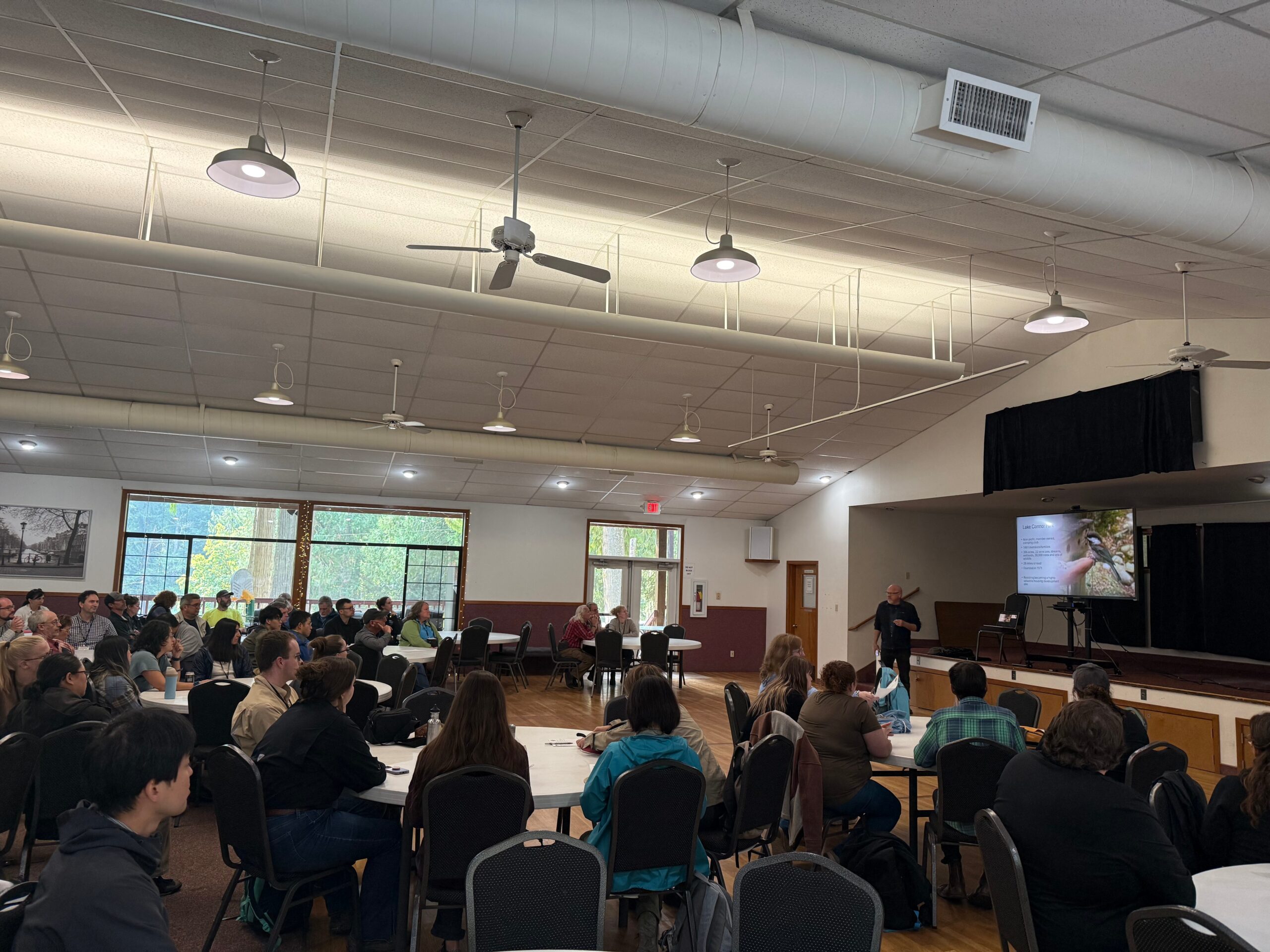
Conference participants learn about forest planning and co-management from Washington State University Extension and community forest owners at Lake Connor Park
UEF’s Strong Presence
The School of Forest Sciences delegation consisted of Teppo Hujala, Nataša Lovrić, Mathew Sloan, and myself, Philip Chambers. We presented research spanning forest advisory services, gamification, and harvesting efficiency. Teppo outlined forest advisory services in Europe through a systems lens, whilst Nataša discussed lessons from the EU-wide FORADVISE project. Mathew presented remotely on advancing cut-to-length thinning efficiency in Central British Columbia.
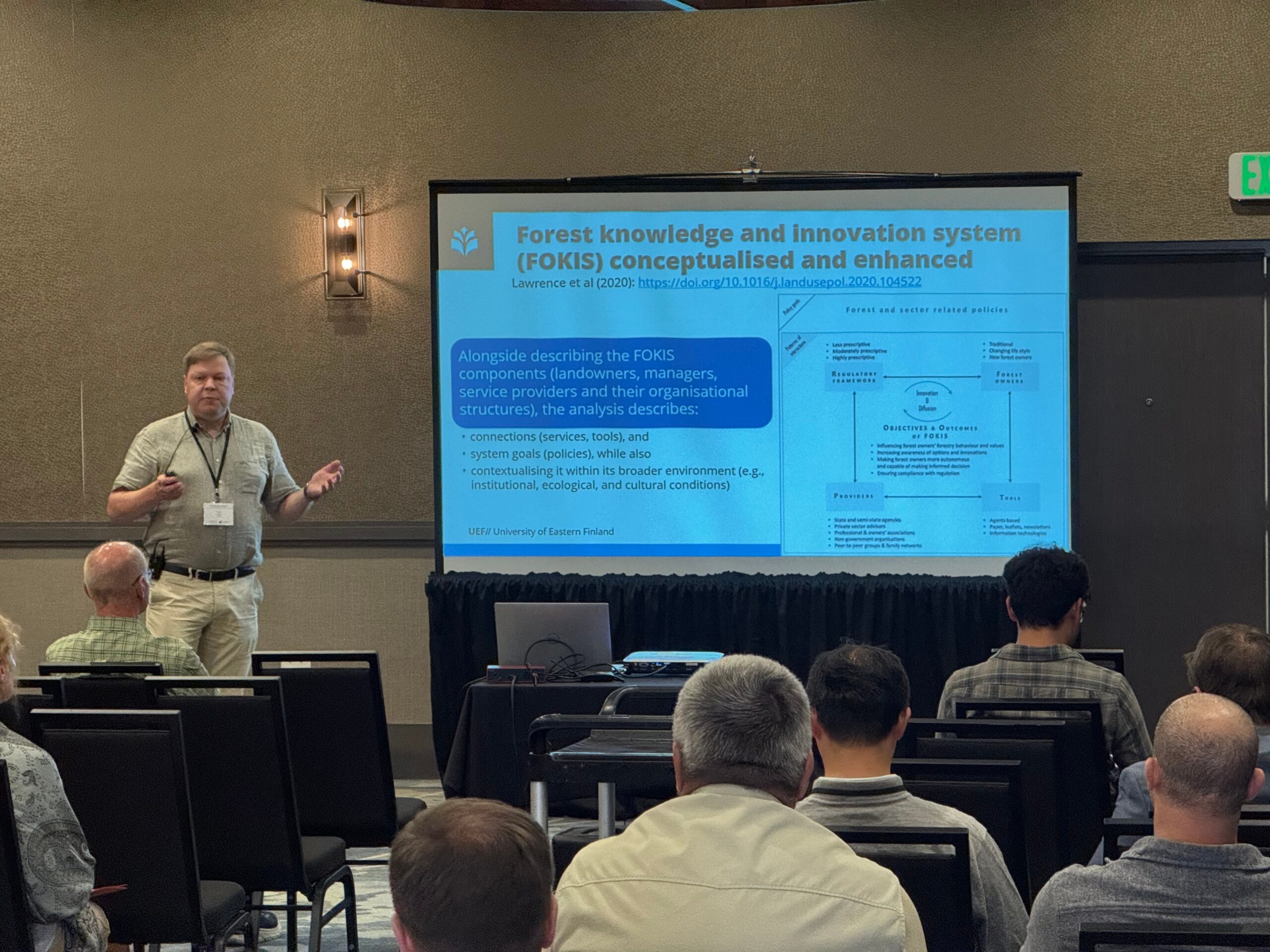
Teppo Hujala presents the work of FORADVISE which will develop a European network of forest advisory organisations, actors, and networks.
My own presentation focused on our “Pelituki” (“GameSupport”) project, which explores how gamified forest information systems can enhance forest owners’ learning and engagement. Working collaboratively with colleagues from Luke (Natural Resources Institute Finland), MTK (Central Union of Agricultural Producers and Forest Owners), and the network of Finnish Forest Owners’ Associations, we’ve developed online learning modules that use game elements, such as narratives, challenges, and achievement systems, to make forestry education more engaging whilst improving learning outcomes and decision-making confidence.
This research sits within UEF’s UNITE Flagship of science and gamification, which investigates forest-human-machine interplay. The gamification work exemplifies how we’re thinking creatively about motivating and engaging forest owners through innovative information systems design.
Learning from International Approaches
Two presentations in particular resonated with potential applications for our work. Lauren Grand from Oregon State University (OSU) showcased “Virtual Canopy,” an immersive VR training programme for future forestry professionals. Meanwhile, Lauren’s OSU colleague, Lorelle Sherman, demonstrated how teaching forestry through foraging can engage new audiences and create alternative entry points into forest education. Both approaches highlighted how innovative pedagogical methods, whether through technology or experiential learning, can broaden participation in forestry.
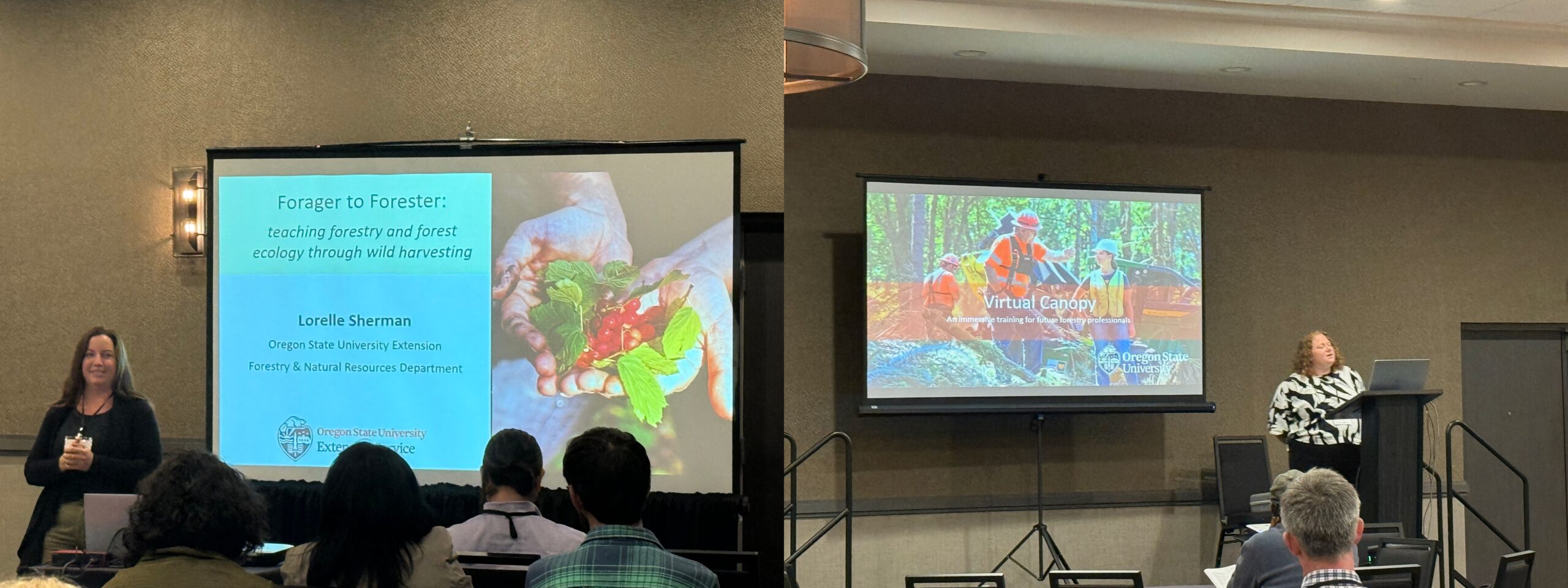
(Left to Right) Lorelle Shermann and Lauran Grand of Oregon State University
Community Forestry in Practice
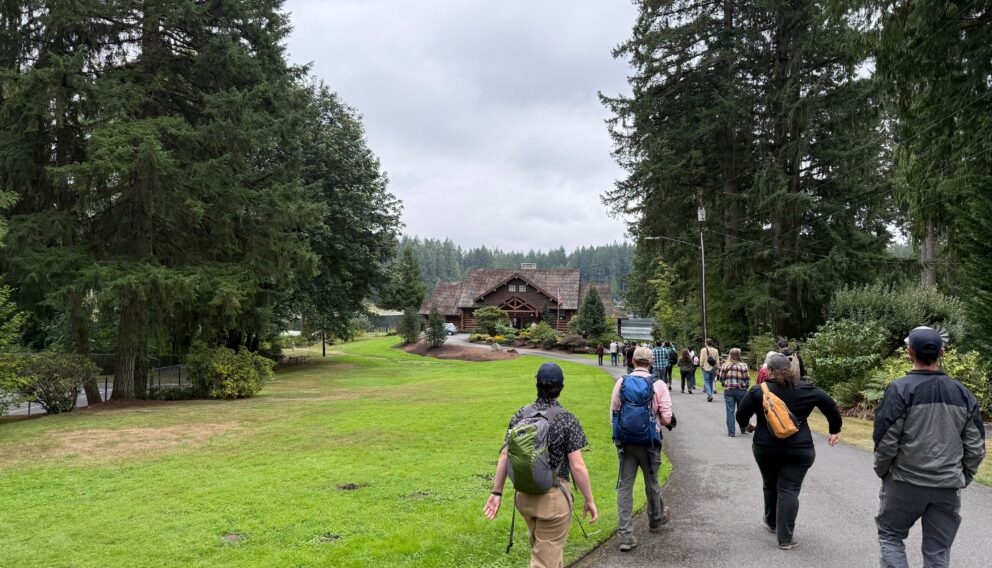
The conference’s field trip offered valuable insights into collaborative forest management models rarely seen in Finland. We visited two contrasting examples of shared forest ownership near Snoqualmie Falls. The first involved forest owners in a holiday home area exploring collective management options. The second featured a decades-old community of property owners around a lake who had proactively developed forest management plans with support from local foresters and extension services, led by conference organiser Kevin Zobrist.
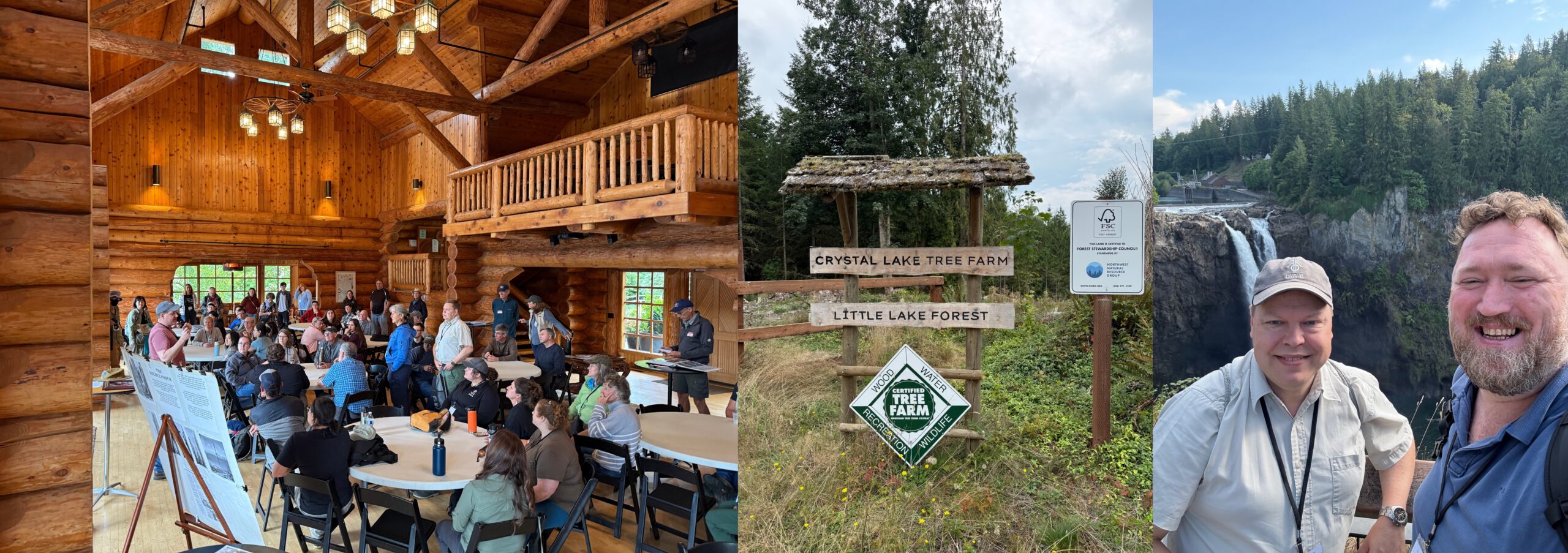
Conference tour to Crystal Lake Tree Farm and Snoqualmie Falls in the Cascades. (Teppo and Philip)
Observing how these communities deliberate, plan, and implement management strategies together, and hearing directly from forest owners about their motivations and experiences, provided fresh perspectives on what collective forest governance can achieve with appropriate extension support.
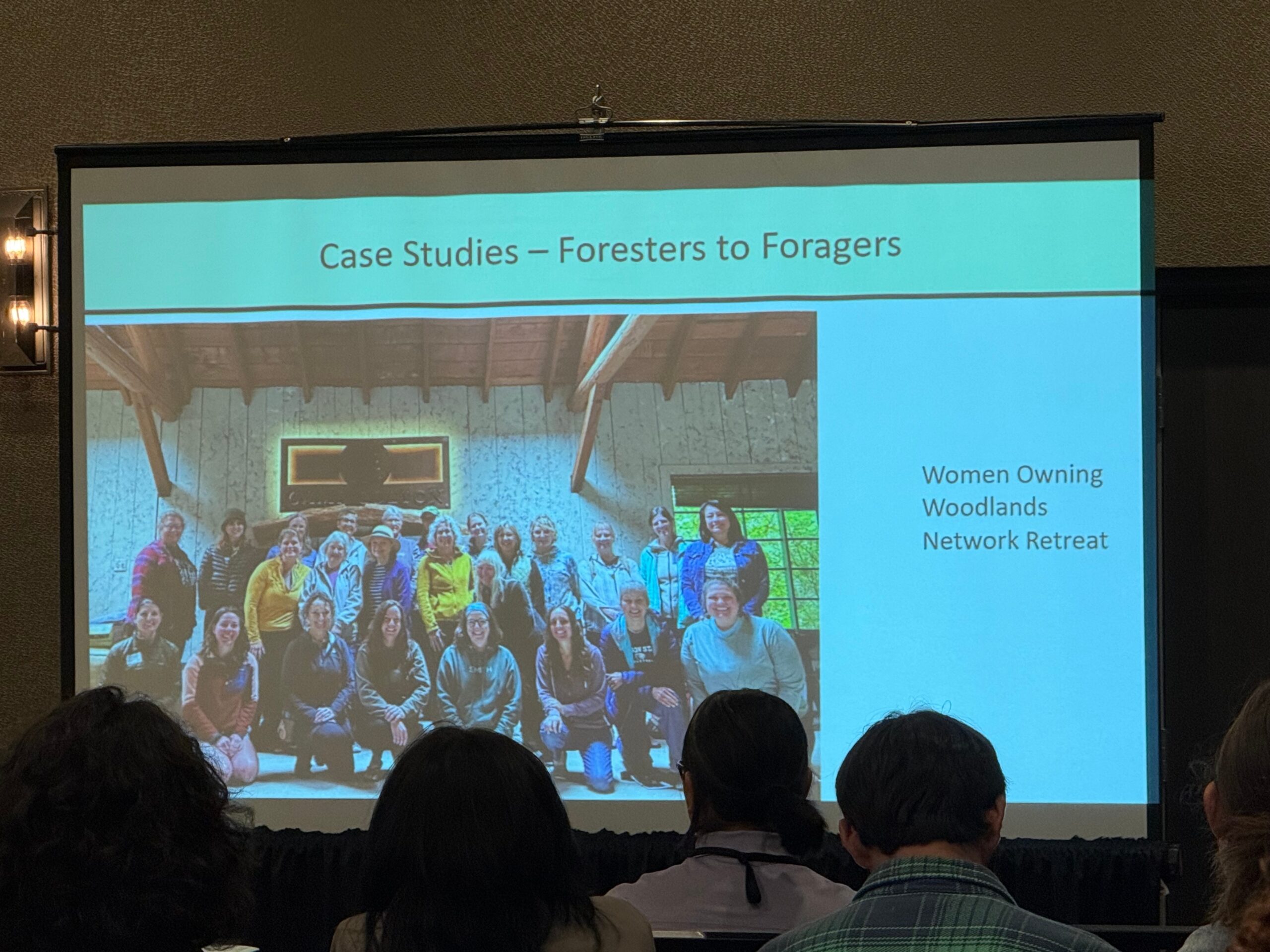
Lorelle Sherman introduced her work on the intersection of forerstry and foraging with women forest owners.
Connecting to Broader Networks
This conference participation aligns with UEF’s growing collaboration with North American institutions through networks like FARIA (Finnish American Research and Innovation Accelerator) and our Sustainable Forest Bioeconomy partnerships with multiple US universities. These connections support research, innovation, and educational exchange in areas including smart forestry, bioproducts, wood construction, and business networks.
The IUFRO conference reinforced that whilst forestry challenges may be globally consistent, solutions require both local adaptation and international knowledge exchange. By maintaining strong research networks and continuing to explore innovative approaches, from gamification to community forestry models, UEF contributes to developing more effective, engaging ways to support forest owners in navigating the complex decisions their forests demand.
Teppo, Nataša and Philip in Everett, WA
