Philosophizing about human rights with Legos: why not?
Hanna-Maria Niemi, University Teacher & Maija Aalto-Heinilä, Senior Lecturer in Philosophy of Law at the UEF Law School
Philosophical foundations of human rights is not an easy topic for teachers or students: it involves, for example, thinking about the nature of humanity, the idea of natural rights, the function that human rights play in the political arena, or the discrepancy between the ideal of equal human dignity and the dehumanizing and ‘othering’ practices of the real world. Yet teaching a course about such serious matters can be fun, if you have a committed group of students who are willing to tolerate their teachers’ whims – such as the teachers’ asking the students to use Lego bricks to illustrate Hannah Arendt’s basic ideas.
Of course, we did other things than played with Legos. The course is a reading seminar in which the students read the assigned texts beforehand and during the seminar sessions work with the texts in small groups. The class work included structured group discussions, as well as drawing mind maps and preparing short power point presentations. In one seminar session, we decided to try something new and see if Lego bricks could be utilized while grappling with the main points of the text in question.
We did not give very detailed instructions to students, rather just gave them the option to use the Lego bricks to present main points of the text if they felt like it. In addition, the groups had discussion questions to reflect on. The groups were small: 4-5 students in each, both Finnish and international.
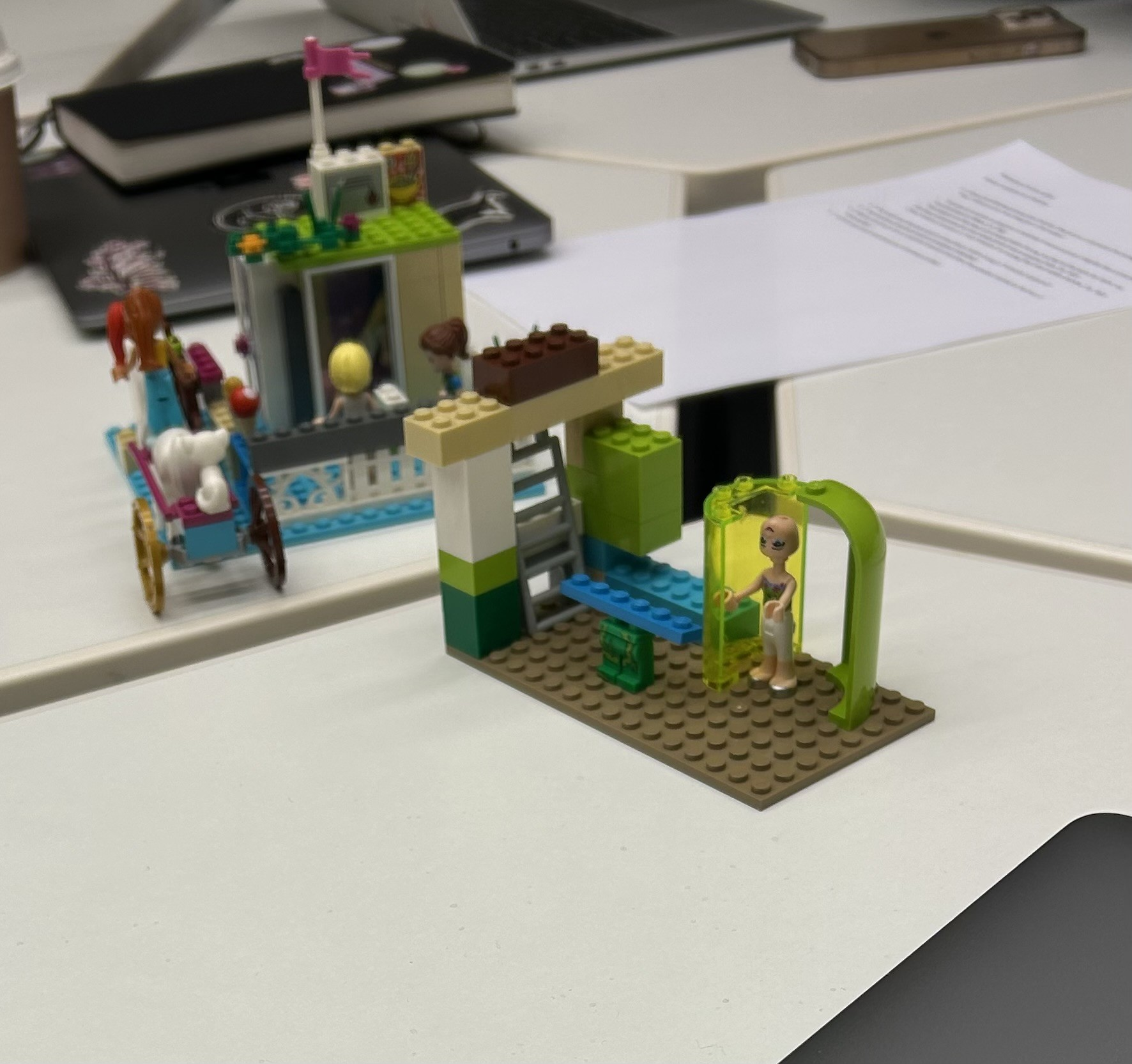
We were a bit unsure about how this experiment would work, but in the end were amazed how well the bricks could be used to visualize and concretize more abstract issues. Doing something concrete with one’s hands while discussing the subject matter helped, we hope, in learning and memorizing the main points of the text. The Legos seemed to spark good discussions and to facilitate teamwork. They also brought back many childhood memories, for both students and teachers, in this way illustrating the little things out of which our common humanity – on which human rights are based – is made of.
The difficulty for us teachers was how to select a suitable collection of bricks for each group (not too many and not too few bricks, about equal amount to each group. We also wanted to include human and animal figures as well as commodities such as some money, food or wheels). Luckily, we both (as parents!) had an extensive collection of bricks at our homes at our disposal.
Another thing to consider – if you get inspired to use this method in your teaching – is to reserve enough time for the students to explain their constructions. We could have reserved more time since the presentations were very impressive and provided a lot of food for further discussions. With the students’ permission, we attach some pictures of their creations. They illustrate Arendt’s concept (from her book Origins of Totalitarianism) of ‘the right to have rights’ and of the failure of human rights to help stateless people after the Second World War.
We are sure this will not be the last time that we use Legos in our teaching. Our experiences also reminded us how important it is to have also on-site teaching – this would not have worked online. Feel free to circulate the idea!