The Border Isn’t Where I Thought It Was
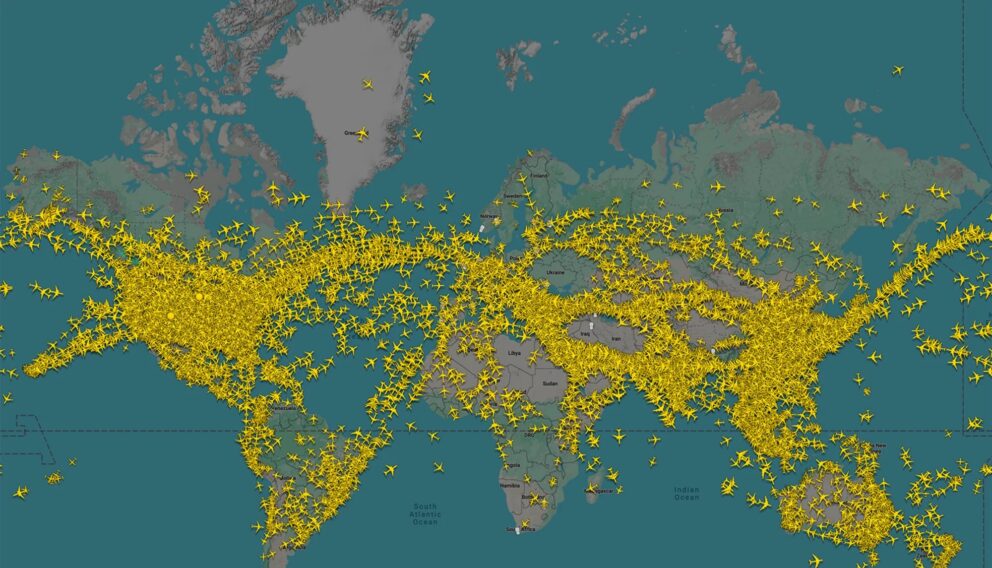
Cover picture: courtesy of Flightradar.
I didn’t set out to write two essays about the same idea. One started as a response to a commentary on pandemic-era bordering, a chance to push back gently on a framework I admired but thought was missing something. The other grew out of a much more visceral prompt: watching, in real time, how a war could sever a flight path I’d taken dozens of times, and wondering why nobody seemed to be writing about that as a border question.
It was only after I’d finished the second piece that I noticed I’d been circling the same problem from two completely different altitudes. One paper is about masks that never arrived. The other is about a flight that nearly ended in disaster, and the thirty years of silence that followed. I didn’t write either one to be about masks or airplanes. I wrote them because both kept leading me to the same uncomfortable question: what happens once the systems doing the bordering are bigger, faster, and more distributed than any single authority meant to control them. They’re both about what happens to the idea of a border once you stop assuming it has to be a line.
What the mask shortage taught me about the border
It started with a fairly simple observation that turned out not to be simple at all. Everyone writing about COVID-era bordering told a story about states reasserting territorial control: closing borders, seizing factories, gating neighborhoods. All true. But the deeper I got into the personal protective equipment (PPE) supply chain literature, the more it seemed like the states weren’t the only ones doing the bordering. The supply chain itself was behaving like a border, deciding who got protected and who didn’t.
That took me a while to see clearly. A supply chain is, at bottom, a long sequence of gateways that double as gatekeepers, and every link decides what gets through and what doesn’t. Under normal conditions that duality is invisible; goods flow, nobody thinks about the switch. But when COVID hit, we discovered how much of the world’s PPE traced back to a small cluster of factories near Wuhan, and how thin the buffer was everywhere else. So when a government closed a border or redirected a factory’s output toward domestic use, it wasn’t imposing order on a well-functioning system. It was one more disturbance landing on a system that was already lurching, and that disturbance didn’t stay local. It rippled outward the way small demand shifts do in the bullwhip effect, amplifying as it moved upstream, until a shortage in one province became a shortage everywhere.
What stuck with me was how little any of this had to do with territory in the end. The border that actually decided whether a nurse in Nairobi or Manila had a mask wasn’t drawn on a map. It was the gap between a hospital with an existing supplier relationship and one without, between a government wealthy enough to outbid its neighbors and one that wasn’t. That’s a border in every sense that matters, since it sorts who gets protected and who doesn’t, and it’s completely invisible on any conventional atlas.
What the sky wouldn’t let me ignore about the border
The airspace piece came from a different place, honestly a more personal one. I kept thinking about how casually we talk about “freedom of the skies,” as if the air above us were some kind of open commons, when the lived experience of flying tells a very different story. Within hours of the 2022 invasion of Ukraine, Ukrainian airspace closed to commercial traffic and airlines everywhere started burning extra fuel to route around it, not because any single authority ordered the whole world to reroute, but because national closures, insurer decisions, and airline judgment calls all cascaded through the same system at once. Nobody was in charge of that outcome. It just happened, the way weather happens.
The deeper I got into this, the less airspace felt like a stable legal fact and the more it felt like something assembled, continuously, out of very disparate materials: technical standards, insurance risk models, automated routing software, historical accident, national pride. The “line” stopped being the right word for any of it. Three things about it kept surprising me as I wrote.
It’s put together, not simply drawn. The actual working units of global airspace, Flight Information Regions, are shaped by radar coverage and traffic density rather than political boundaries, and they often straddle several countries without much regard for who owns what below. Layer Air Defence Identification Zones on top of that, unrecognized by international law yet enforced anyway, and you get places like the Taiwan Strait, where the same stretch of sky answers to more than one authority depending on the day.
It acts before you’ve moved an inch. Long before a plane leaves the ground, flight-planning software has already filtered its route through political no-fly zones, fuel math, and predictive models of where trouble might be. When Middle East airspace closed in 2025, airlines adjusted almost instantly, not because someone made a fast decision under pressure, but because the contingency routes had been sitting in the navigation systems for years, waiting. The border was already inside the machine before the crisis ever started.
And it stretches. Really stretches. COVID gave us the first genuine experiment in near-total airspace closure, produced by no single government’s decree but by the collision of national restrictions, vanishing insurance coverage, and collapsing demand all at once. The invasion of Ukraine did something similar on a smaller scale. So did the 2025 strikes across the Middle East. So, in a slower and more grinding way, does the daily contestation over the Taiwan Strait, which never resolves into either peace or war but just sits there, permanently unsettled.
Where the two ideas meet
I didn’t expect these papers to rhyme this closely, but they do. In both, the border isn’t really something a state does to an otherwise calm system. It’s something that surfaces from a system that was already primed for volatility (a handful of PPE factories, a handful of satellite constellations and insurers), and a geopolitical shock doesn’t so much cause the instability as reveal it. It was there the whole time, just waiting for a reason to show itself.
And in both cases, the people who actually feel the border aren’t standing at a checkpoint. It’s the hospital administrator without a supplier contract. It’s the passenger who never notices their flight got quietly rerouted over the Arctic. It’s nobody standing anywhere in particular, which is precisely what makes this kind of bordering so hard to see and so hard to hold anyone accountable for.
What surprised me most, looking back, is how often what feels like an exception turns out to be the system’s actual resting state. The surveillance infrastructure built during the pandemic didn’t vanish once case counts dropped; it got absorbed into everyday digital governance, waiting. The overlapping claims over the Taiwan Strait aren’t a crisis on pause; the contestation is the condition, every single day, incursion after incursion, with no resolution scheduled.
Why I keep coming back to this
I think the reason I couldn’t let either of these topics go is that the standard picture of a border (a line, a checkpoint, a single sovereign deciding who passes) keeps failing to explain what I was actually watching happen. That picture assumes there’s one entity in charge, one place where the decision gets made. But once you’re looking at a system where insurers, algorithms, logistics managers, and half a dozen overlapping international bodies all have a hand on the wheel, “who’s in control here” stops being a question with a clean answer.
That’s not just a theoretical quibble. It matters because our crisis reflexes (close the border, seize the factory, ground the flights) are built for a world of single sovereign actors, and they keep getting deployed against problems that are actually networked, recursive, distributed. I don’t think I’ve solved that mismatch in either paper. But I think naming it is a start, and I suspect I’ll keep circling it, because once you start noticing borders that aren’t lines, it’s hard to stop seeing them everywhere: in the sky above you, in the shipment you’re still waiting on, in all the ordinary places nobody thinks to call a border at all.
This post draws on two of my papers, where the arguments above are developed in full and with proper scholarly apparatus:
Laine, J. P. (2026). Viral borders, system shocks, and the limits of territorial thinking. Dialogues in Human Geography. https://doi.org/10.1177/20438206261463544
Laine, J. P. (2026). The elastic sky: Airspace, volumetric bordering, and geopolitical crisis. Global Studies Quarterly, 6(3), ksag133. https://doi.org/10.1093/isagsq/ksag133