
What I Chose to Know: Notes from the Possibility Studies Conference
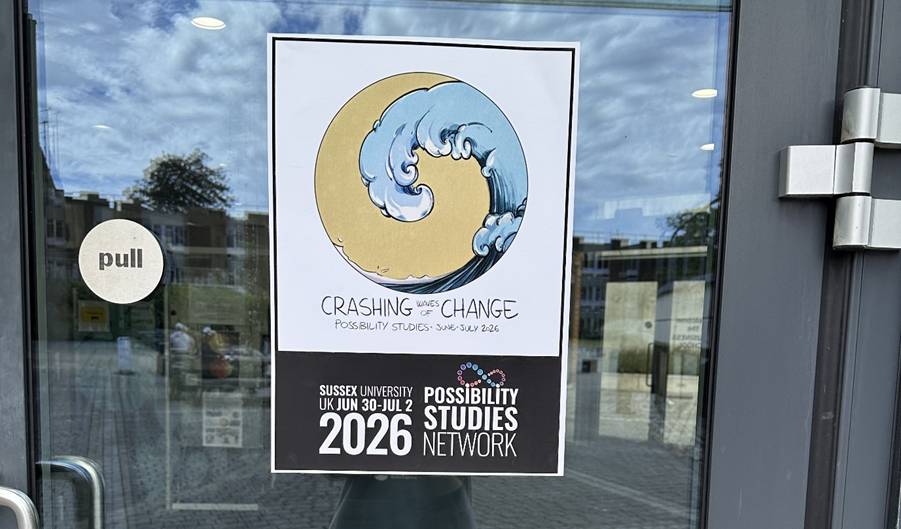
The6th International Conference of Possibility Studies took place this July at the University of Sussex, Brighton, England. I’d like to share my experiences with you, for two reasons.
The first reason is personal. Obviously, for an academic, there are many reason to attend a conference: research dissemination, visibility, networking, visiting a place you would otherwise wouldn’t, etc. But the main reason I keep returning to this particular conference is that the people who attend it remind me of who I want to be as a researcher. Reading the abstract of Kerry Chappell’s keynote brought this into focus. It was about the power of marginalised ways of being and knowing – imagination, curiosity – in research. It reminded me of my favourite moment in the research process: the exploration of the problem, before it transforms into a research proposal, when I let creative thinking and intuition run loose in search of the next big idea.
Placing what makes us human at the centre of the work is not specific to research. Whether it is creative thinking, compassion, or empathy that we choose to put at the centre of our working identity, the choice opens a space for growth – alone or with others – toward the best emotional states and ideas we are capable of.
This brings me to the second reason for which I am sharing my conference experiences with you: I believe researchers are in one of the best spaces of growth when engaged in communication with the public, the potential beneficiaries of their findings. At a conference like this one, that conversation runs both ways: there is what I take from other people’s work, and there is what happens when I put my own in front of an audience that does not share my vocabulary. Both are worth describing.
Choosing what to attend
Across three days there were many parallel tracks bringing into focus aspects of human experience we might not otherwise pay attention to. For example:
- How to design creative practices to support undergraduate students’ socio-emotional learning.
- How power circulates through ordinary interactions shaping who participates, adapts or withdraws from organizational life.
- How creativity contributes to sustaining the relationships we value the most.
Do you now see my dilemma? Choosing between the sessions was like reading a menu of tantalising dishes and being allowed to order only one. But on what criterion?
I settled on the proximity principle: attend the session closest to your own. That took me to Ethics, Power and Possibility, where three ideas stood out – each with something you might try in your everyday:
- What do you consider to be your reality? And who controls it?
In Pier Paolo Bellini’s presentation, “Playing God”: possibilities, power, and ethics in virtual worlds, the starting point was that our body is no longer the primary interface with the world. Digital technologies arrive with an abundance of images and stories that carry us from physical reality into a virtual one. Immersive virtual reality quietly reshapes how we perceive and what we trust, and because its workings are hidden from the user, it can be used to manufacture belief and consent – which makes the ethics of world-building an urgent question rather than a theoretical one. What is one core belief, say on what is a good leader? Where did you develop it?
- Are you the kind of person who makes donations? How do you decide which causes deserve them?
Carina Wong’s presentation, Designing for possibility: Reclaiming imagination in philanthropy, examined how large philanthropic foundations distribute resources. Foundations have everything they need to imagine big, but the measurement tools they borrowed from consultants shrink what anyone dares to propose. The study traces how that narrowing happens, and what skills and conditions would widen the range of futures that remain thinkable. So, if you give money to philanthropy, why leave the agenda to someone else? What idea would you propose funding? What would you accept as evidence it was working, if not a number?
- Have you noticed the creative elements in your neighbourhood or your workplace?
In the presentation on Reframing Creative Space in Urban Transformation, the authors explored how creative spaces can create sustainable urban change. Based on work with professionals from 15 Dutch municipalities, the brainstorming workshops began from a policy premise: that creative space means providing cheap studios and workspaces for artists and creative businesses.
The authors’ objection is that this policy misses on what creativity actually does in a city. Creative activity also shapes neighbourhood life, ecological practices, and circular economy initiatives. Treating creative spaces as a workspace supply matter leaves no room to recognise or support any of that.
Next time you go on a walk, look around and see what is the creativity around you that has no studio: the artistically painted bench, people dancing in the park, the way a street corner is designed for something you haven’t seen elsewhere, etc. How much of what makes your neighbourhood feel alive would show up in a municipal budget line? Who would notice if it disappeared?
Turning the question inward
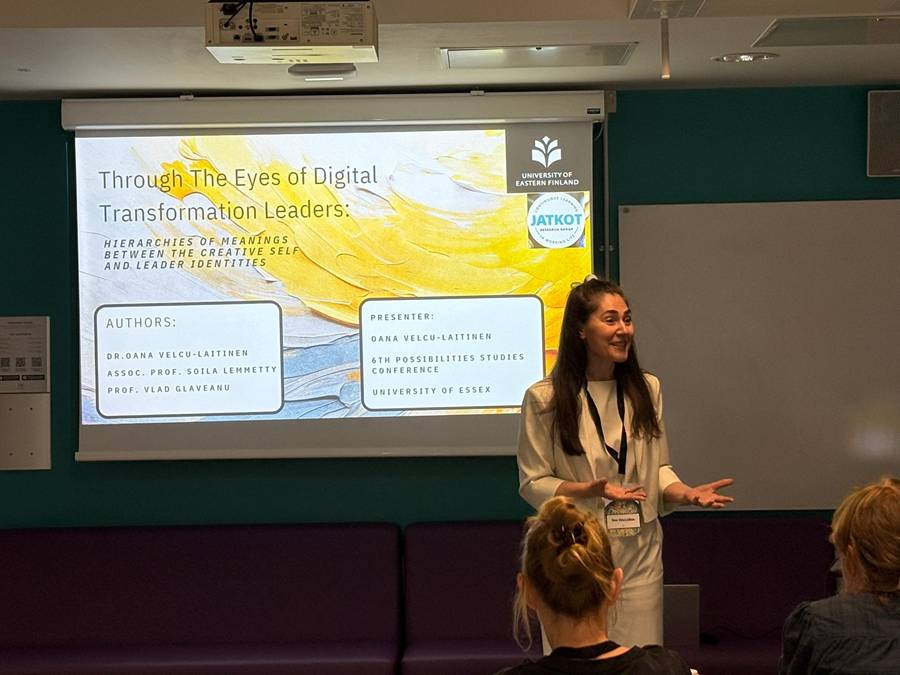
Then I presented the research paper written with Soila Lemmetty and Vlad Glăveanu: Hierarchies of meanings between creative self-image and leader identities. Our research turned the question inward – not to city streets or philanthropy budgets, but to the person making the decision.
Our focus was on a specific group of individuals, digital transformation leaders whose main responsibility is to make sure that the digital initiatives are carried out successfully. They are accountable for delivery and hold teams together. People in that position develop identities as leaders. At the same time, many of them think of themselves as creative individuals: as someone who generates ideas, who reframes problems, who takes initiative to try something that hasn’t been done here before.
These two identities – as a leader and as a creative person – don’t carry equal weight. One tends to sit higher than the other in a person’s internal ranking – and that ranking is what we call a hierarchy of meanings. The hierarchies shift with the context, and what moves them is what a person values most from their work experiences – whichever kinds of rewards.
Most of us, you included, carry more than one identity into our work. Which of your professional identities is currently on top? What were the consequences the last time you prioritised it?
I left Brighton thinking about research communication and how difficult it is to carry a message through – to see it land in the audience’s eyes: “Ah, so that’s what this paper does, and that’s how it could be taken into use.” Compressing the essentials of a study into a slide deck for people who inhabit different mental spaces is demanding work, and it is one more reason the Possibility Studies conference is worth attending. The audience comes from enough different walks of life that almost any comment on my research expands my own horizon of what it could be for.
What we choose not to know
Which brings me back to the menu. My small dilemma about which session to attend turned out to be a version of what Selene Arfini presented wittily in her keynote, R(el)ational ignorance: How Not-Knowing Knots Knowledge and People Together. How much of any relationship rests on what we don’t know about ourselves and each other?
Ignorance isn’t stored inside one person’s head. It’s spread across people, tools, and environments. You don’t know how your doctor reached your diagnosis, how your bank’s software works, or what your colleague did all afternoon – and you don’t need to, because those relationships come with an implicit division of expertise. What you don’t know, and why, reveals who you trust, what you’ve handed off to someone else, and what your role does and doesn’t require of you.
Ignorance, then, is not the disadvantage it sounds like. What you can do is choose whom to rely on for what you need to know and accept the rest: that some things you don’t need to know, and others you could never know, because no one can know it all. Seen this way, ignorance is a condition of acting sensibly rather than a failure to do so. It shapes what we can learn from others, when we can lean on their experience, and why we sometimes choose not to know. And since each of us occupies only a sliver of what could be known, moving through the space of possible knowing is unavoidably a relational, ethical, and creative undertaking.
So, at the beginning of a new day, ask yourself, “What do I choose to know?”, “Why?” and “How?”.
-Oana Velcu-Laitinen, JATKOT-research group