
Mythical Breakthroughs or Everyday Experiments? Insights from the EDLI Project on Innovation, Learning, and Competence at Work
Between 2022 and 2025, the Research Council of Finland funded my postdoctoral research project, Employee-Driven Learning and Innovation (EDLI), which examined employee-driven innovation through a learning-theoretical lens in both policing and the technology sector. The project sought to understand how employee-driven innovation emerges and manifests itself in these contexts, as well as the challenges associated with innovation and the organizational support required to sustain it.

For the study, I interviewed 32 professionals from the technology sector and 24 police officers engaged in preventive policing across Finland. In addition, some participants took part in follow-up group interviews and a six-week diary study in which they documented their everyday work experiences using a mobile diary application. In the technology-sector organization, I also conducted several days of workplace observation, recording my observations in a field diary.
Why Study Employee-Driven Innovation?
Innovation is perhaps more frequently emphasized today than ever before. Yet dominant understandings, and much of the existing research literature, continue to portray innovation as primarily the responsibility of product developers, managers, and entrepreneurs, with innovation initiatives then implemented throughout the rest of the organization.
If our goal is to develop not only economically beneficial innovations but also social and human-centered innovations, that is, new and valuable products, practices, and ways of working, we need a much broader range of participants involved in innovation processes. Employees possess extensive expertise regarding their work, work practices, customers, and stakeholders. Why, then, is this competence potential so often overlooked in innovation activities?
Perhaps because we still know relatively little about how employee-driven innovation is constructed and manifested in the everyday realities of organizations. This gap in knowledge motivated the EDLI project.
Why the Police and the Technology Sector?
Can police work be innovative? Why study innovation in the technology sector, where innovation has already been extensively researched? For the EDLI project, I wanted to select occupational contexts that differed substantially from one another while both representing complex and multifaceted forms of work.
The police are rarely the first group that comes to mind in innovation research. In my view, they should be. Police officers operate on the front line of responding to complex societal challenges, many of which have become increasingly visible in recent years. This requires the ability to develop new solutions within legal and organizational frameworks while balancing multiple perspectives.
I wanted to understand how innovation is perceived within policing, what innovations look like in practice, and how employees are able to participate in innovation processes. During the interviews, I asked officers why the police should be innovative. One experienced senior constable responded:
“So that we can keep up with developments in contemporary society. We are always behind. Our organization changes only when it has no other option.”
Why did this participant perceive the police as constantly lagging behind or changing only under pressure? Is policing really as non-innovative as this statement initially suggests?
The technology sector, by contrast, is characterized by continual change and diversity. The participating organization was a medium-sized high-technology company operating both in Finland and internationally. Participants represented product development, production, marketing and sales, administration, and management. I assumed that product developers in particular would naturally define innovation in terms of new products, patents, and technologies, and therefore see innovation as a self-evident part of their work. This was not the case. Surprisingly, many experts struggled with the very definition of innovation itself. As one participant reflected:
“What do you mean by innovation? The hardest part is understanding what actually counts as an innovation.”
It is remarkable that even highly experienced product development specialists may find the concept of innovation difficult to define. If innovation is not a straightforward concept for experienced experts working at the forefront of technological development, how can we expect its meaning to be self-evident for all employees?
How Does Employee-Driven Innovation Emerge?
According to the findings, employee-driven innovation does not happen by accident. It rests on three foundations: competence, learning, and participation. Employees’ innovation agency is shaped both by their own willingness and enthusiasm to develop new ideas and by the opportunities and constraints created by the organization and its environment. The EDLI project identified three forms of innovation agency (see Lemmetty, 2026; Welling, 2025):
- Direct Innovation Agency: Individual innovation efforts and organizational opportunities support one another. Participation in innovation is recognized, supported, and genuinely enabled
- Seeming Innovation Agency: Despite a willingness to innovate, employees lack meaningful opportunities to influence outcomes. Participation remains largely formal or symbolic.
- Rebellious Innovation Agency: Innovation is pursued outside formal structures, norms, or decision-making channels. Employees assume a shadow role that may lead to uncontrolled self-direction within the organization.
Participants emphasized several competence areas as essential for innovation: Subject-matter and practical competence, organizational and cultural-historical competence and, attitudinal and motivational competence. However, ideas and expertise alone do not automatically become innovations. Employee-driven innovation emerges when different forms of competence are combined through collaborative processes involving alternating periods of adaptive and innovative learning.
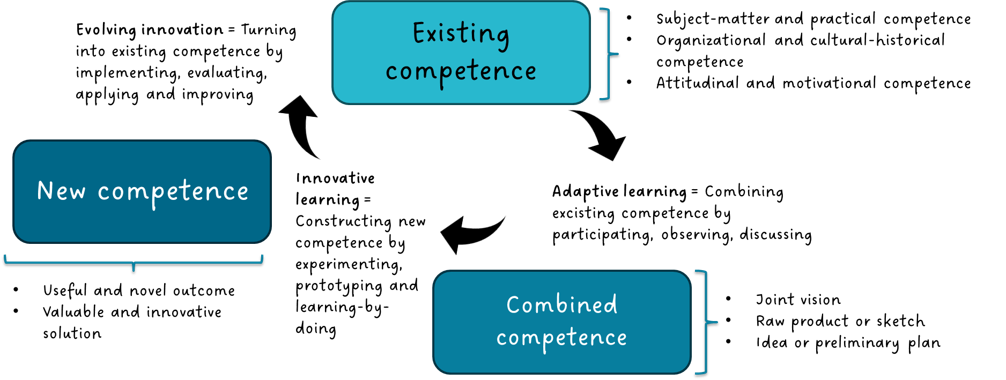
Figure 1. Expanding competence through learning practices in different phases of the innovation process (Lemmetty, 2026)
Adaptive learning involves acquiring existing knowledge, competence, and practices through observation, participation, and discussion. Innovative learning focuses on creating new knowledge, solutions, and practices through experimentation, testing, and learning from errors.
These learning processes form a continuous cycle. The solutions, practices, and outcomes generated through learning provide the foundation for future learning and innovation.
How Does Employee-Driven Innovation Manifest Itself?
One of the central findings was that employee-driven innovation is best understood as a continuous process rather than a discrete event. Participants frequently described innovation as a shared journey, in which different actors join at different stages and shape the overall outcome through their contributions. Many innovations related to work practices, organizational routines, and work environments originated from observations made during everyday work and gradually developed into solutions that ultimately benefitted the entire organization.
To understand this process, the study drew on the possibility thinking framework (Glăveanu et al., 2024). According to this perspective, creative activity progresses from recognizing possibilities to becoming interested in them, exploring them, and experimenting with them. Innovation, however, occurs only when the creativity of individuals or groups results in a solution that is accepted and implemented by the organization. The following ‘composite ‘type-story’ illustrates this continuous nature of innovation:
“Major innovations, such as new products or significant organizational changes, are rare occasions worth celebrating. That is why innovation is difficult to grasp as a whole. In this work, innovation means solving small problems as part of a larger process. We break down individual problems and complexities into smaller parts and seek the best possible solutions to each of them.
The challenge is that it does not feel as though we are innovating or building innovations. These small pieces, these incremental advances, do not seem particularly meaningful or valuable from the perspective of innovation. Instead, the sense of value and achievement should come from the journey itself, from continuous learning and gradual progress. Sometimes it is necessary to stop and look back at that journey, to see the leaps forward that all those small pieces have produced.
Many employees have long careers within this organization. They can see the journey, the bigger picture, and understand the significance of individual steps. Every product and every outcome builds the foundation for future products and outcomes.Innovation is evolutionary by nature. It is about continuous innovation, but through small steps.”
What Makes Innovation Difficult?
Although employee-driven innovation emerged as a significant organizational resource in both contexts, the study also identified several challenges. Innovation is often essential in preventive police work because its purpose is to identify and address social problems before they escalate. However, unclear objectives, resource constraints, and performance-based metrics may limit opportunities for long-term development. Participants also identified organizational hierarchy as a challenge. Although supervisors often sought employee input, employees’ perspectives did not always reach decision-makers. As a result, development initiatives could be left unsupported or become informal attempts to influence change.
In the technology sector innovation is often more deeply embedded in organizational culture, yet it faces its own constraints. Growth, geographical dispersion, and remote work may weaken the social practices upon which learning and innovation depend. Innovation in technology organizations relies heavily on competence diversity, meaning that different perspectives, knowledge bases, and skills can be combined in collaborative development processes. Such collaboration requires trust, interaction, and informal knowledge sharing. When work occurs primarily through remote technologies, tacit knowledge transfer, spontaneous discussions, and collaborative problem-solving become more difficult.
Regardless of sector, the greatest obstacle to innovation was rarely a lack of ideas. The primary challenge was getting ideas to move forward within the organization. Many ideas fail because there are no clear pathways or organizational mechanisms to support their development. Consequently, organizations may experience either uncontrolled self-direction or the premature stagnation of innovation efforts.
Concluding Reflections
At the beginning of this article, I posed two questions: Why is the concept of innovation difficult even for highly experienced technology experts whose job is to create innovations? Is policing really as non-innovative as the senior constable’s comment initially suggested? We have become accustomed to thinking of innovation as something almost mythical: world-changing breakthroughs achieved by exceptional individuals far removed from ordinary work and everyday people. This perception helps explain why technology professionals, and perhaps even more so police officers, do not always view their own work as innovative. The prevailing image of innovation establishes an unrealistically radical benchmark against which ordinary development work is judged. In the technology sector, innovation is difficult to recognize because innovation is fundamentally a continuum. It evolves gradually through small improvements, learning, and collaboration. Within this process, individual contributions can easily become invisible. The answer regarding policing is more nuanced. The findings suggest that police work is far from non-innovative. Preventive policing, in particular, involves continuous development and adaptation. Police officers are capable of innovating and do innovate. However, strong power hierarchies, participation barriers, and ambiguities regarding objectives and boundaries can hinder innovation. Despite these challenges, the innovation potential of police organizations is significant if organizational cultures can better support employee participation and learning.
What Did the Project Contribute?
The primary purpose of research projects is to generate research-based knowledge and thereby contribute to the scholarly literature, theoretical discussions, and conceptual understanding within a field. At the same time, research helps to make sense of complex phenomena and to understand human behavior across different situations and changing operating environments. The EDLI project produced:
- 10 peer-reviewed scientific publication
- 2 academic books
- 10 reports, commentaries, or discussion papers
- 6 master’s theses
- 6 blog articles
- 4 organizational feedback reports
- Numerous conference presentations and expert lectures
Research often has broader societal and practical impacts beyond its academic contributions. From the perspective of adult workplace learning and innovation, the benefits of the EDLI project are particularly connected at the societal level to discussions on continuous learning and research, development and innovation (RDI) activities, and at the practical level to the development of workplaces and organizations.
The most significant contribution of the EDLI project is making innovation visible as a learning-based, employee-driven, and participatory process. At the same time, the project identifies factors that support or hinder the emergence and development of innovations in different workplace contexts.
At the societal level, the research offers a new perspective on innovation by demonstrating that innovations are not created solely by managers, entrepreneurs, or product developers, but also by employees as part of their everyday work. In doing so, it broadens the discussion on research, development, and innovation from a focus on economic innovations toward social, human-centered, and learning-based innovations. The findings support lifelong learning policies by highlighting the connections between learning, participation, and innovation, while emphasizing the importance of employees’ expertise and involvement in addressing societal challenges. The study also made visible the innovation potential of the public sector and, within the technology sector, the creative contributions of employees beyond product developers.
From the perspective of workplaces and organizations, the research deepens our understanding of how innovations actually emerge by showing that they are often built through incremental improvements embedded in everyday work rather than solely through formal development projects. The findings underscore the importance of trust, interaction, and collaborative learning as prerequisites for innovativeness. The study highlights the central role of competence diversity as a source of innovation and demonstrates the importance of knowledge sharing, collective learning, and collaborative development in organizational renewal.
In addition, the research provides insights into how employee participation can be strengthened and how organizational structures that support innovation can be developed. At the same time, it identifies structural and cultural barriers that can impede innovation, such as factors related to power relations and organizational culture in policing, and challenges arising from organizational growth, distributed work, and remote work in the technology sector.
What Comes Next?
Although the EDLI project has concluded, the research continues through several new projects:
- Ethical Police (Kone Foundation, 2026-2029)
Examining the development of ethical competence in police education and everyday policing. - TYSTI: Innovation and Work Engagement (Finnish Work Environment Fund, 2026-2027)
- Investigating the relationships between innovativeness, workplace well-being, and workplace pedagogy.
- ETLI: (Un)Ethical Learning-Based Innovation (Research Council of Finland, 2026-2030)Exploring the consequences of innovation and developing frameworks for assessing and anticipating innovation responsibility and ethics.
All three projects share a common goal: building a sustainable and humane working life through research. Learning and innovation do not automatically produce well-being or ethically sound outcomes. Their consequences, values, and impacts therefore deserve broader scrutiny. We do not need learning and innovation solely for economic growth. We need them to create socially sustainable, responsible, and human-centered practices.
- Soila Lemmetty – JATKOT Research Group
More: