
What Does the Future of Leadership Look Like? Exploring New Currents in Leadership Research in Paris
The 21st European Conference on Management, Leadership and Governance took place on 13–14 November at the CESI Engineering School campus in Paris-Nanterre. The event brought together timely discussions on leadership, showcasing research across a wide spectrum – from digitalisation and sustainability to cross-cultural collaboration. A shared underlying question was how organisations and leaders can act ethically and effectively amid uncertainty. For a researcher examining organisational strategic change through the lens of interactional learning processes, this conference was a particularly fitting choice.
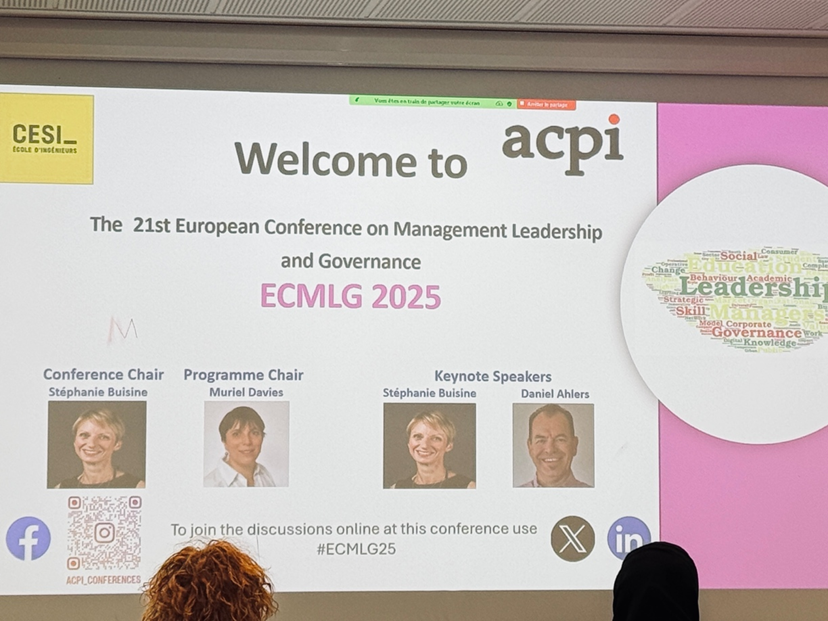
For my first international conference, I set myself two goals: to build new networks and to learn more about topics that interest me. With this in mind, I eagerly attended the registration and networking event at the conference hotel on the first evening, hoping to make international connections. The first person I spoke with – in English, of course – turned out to be Finnish after all. Nordic representation was strong more generally, as researchers from Sweden and Norway soon joined us. However, as the conference progressed, its international character became clear, and I met people from almost every continent.
The first official conference day began with a presentation by Stefan Seiler, Director of CESI, who spoke about changes in working life and, in particular, the role of new generations in this change. According to Seiler, Generation Z values somewhat different things at work than previous generations, such as flexibility and social and ecological responsibility. He suggested that from employees’ perspective, skills such as teamwork, critical thinking, and innovative problem-solving will become increasingly important in the future, as learning plays a central role in organisational development. As an adult education scholar, I found myself nodding along in agreement.
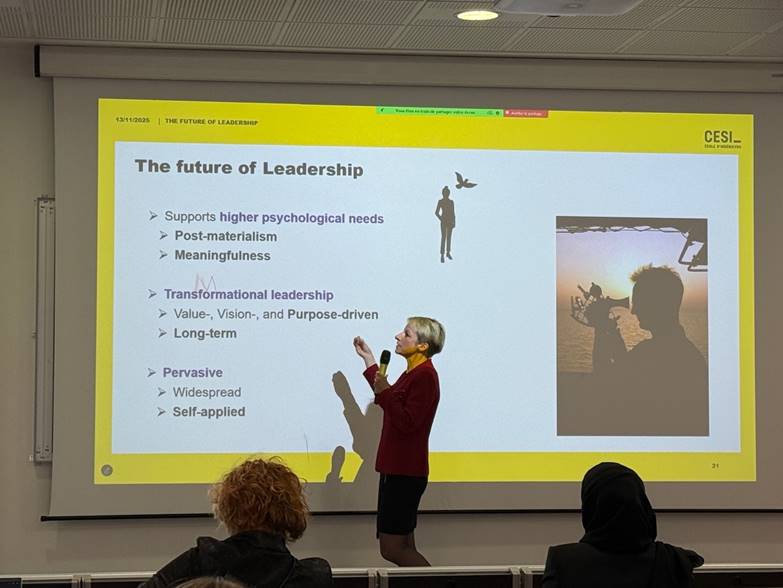
Following the opening address, CESI’s Research Director, Stephanie Buisine, delivered a keynote on the future of leadership. Drawing on her research, she described how humanity’s social development has gone hand in hand with technological advancement, both at the societal level and within organisations. According to Buisine, traditional transactional leadership – based on rewarding and punishing employees – is no longer a sustainable solution in today’s transformed world of work. Instead, transformational leadership is better suited to contemporary working life and to leading new generations, as it is grounded in understanding and supporting employees’ values and sense of meaning. As such, it represents a sustainable and engaging approach to leadership. But what, then, can we expect from the future of leadership? Buisine predicts that the traditional model in which individual leaders steer organisations will gradually give way to flatter hierarchies, where leadership is more widely shared among organisational members. An engaging and thought-provoking presentation.
At a leadership conference, one naturally encounters a wide range of leadership styles. Based on what I might call a “gut-feeling sample,” I would say that transformational leadership stood out in the research not only quantitatively but also qualitatively, in terms of content. Based on the presentations, it appears to support, among other things, the emergence of innovation, interaction, and employees’ experiences of meaningfulness. From the perspective of adult education, it was particularly gratifying to see learning highlighted in many studies, with discussions touching on concepts such as informal learning and the learning organisation.
One study examined how leadership develops through observing and adopting role models, identifying informal learning as a key mechanism. Importantly, the study also highlighted a point that is rarely discussed: learning can lead to negative outcomes when poor practices or behaviours are adopted from colleagues or supervisors. Ecological sustainability and artificial intelligence also emerged as prominent themes across the research presented.
On the second conference day, Daniel Ahlers delivered a practically oriented keynote on resolving conflicts within teams. According to Ahlers, consistent coaching can effectively address challenges arising from differing and even conflicting needs within teams. Central to this process is identifying individual team members’ needs and wishes and jointly finding ways to reconcile them in a manner that serves everyone. In the practical approaches he presented, I recognised features and connections to self-determination theory.
Later that day, it was my turn to present a poster based on a work-in-progress article published in the conference proceedings. This study, which examines the relationships between workplace learning potential, psychological safety, and organisational strategy implementation, attracted considerable interest and sparked fruitful discussions about how strategy ultimately comes to life and is enacted in everyday organisational practices through learning and interaction. For me personally, the presentation was also an important learning experience and an opportunity to reflect on my research through the perspectives of other scholars. Link to the article: https://doi.org/10.34190/ecmlg.21.1.4248
The conference concluded with an interactive lecture by Professor Dan Remenyi entitled Philosophical Conversation with AI, in which he engaged in a dialogue with ChatGPT on philosophical questions related to research. Three points in particular stayed with me:
- Artificial intelligence should not be trusted blindly.
- Using concepts and language in science requires great precision.
- A reflection inspired by Bertrand Russell: the only thing we can be sure of is that we don’t know what we don’t know.
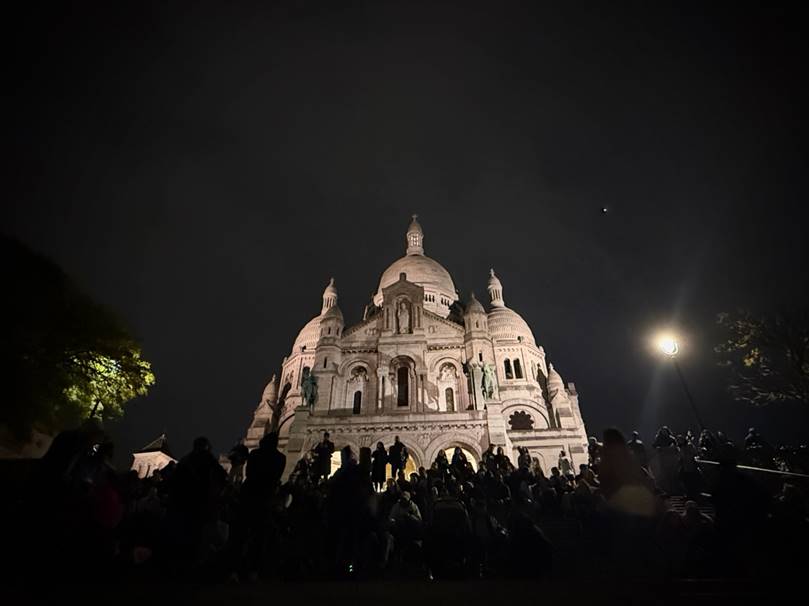
Despite the packed conference schedule, there was also time to admire some of the city’s famous sights, observe French everyday life, and go for runs along the Seine. During an evening walk at the top of Montmartre hill, on the steps in front of the Sacré-Cœur Basilica, I witnessed not only the striking silhouette of the metropolis but also a moment in which around fifty random evening wanderers spontaneously joined together to sing Bob Dylan’s Knockin’ on Heaven’s Door, accompanied by a street guitarist. Descending from that atmosphere and down the countless steps back toward the edges of the city centre, I realised long before boarding the plane home that Paris still holds many streets and alleyways waiting to be explored more closely.
All in all, the conference trip was a successful and inspiring experience, and an especially rewarding one from a learning perspective. It offered an excellent opportunity to pause and engage with current research themes and to exchange ideas within the international research community. Mission accomplished: returning home, I was richer in new contacts, ideas, thoughts, and experiences.
Whether the future of leadership becomes increasingly shared and less hierarchical or not, I am convinced that interaction and learning will remain at its core, as strategy is ultimately enacted through the collective practices of everyday work – already today.
À bientôt, Paris.
Teemu Ojala, PhD researcher