Transforming Our Perspective on Sustainability: The FUTE Student Mobility Experience at UNAM, Namibia
By Mr. Zephania Malongo and Ms. Stella Mntambo, Postgraduate Students
In September 2025, we stepped into an extraordinary journey that blended academic discovery, cultural immersion, and hands-on sustainability learning. Thanks to the FUTE Student Mobility Exchange Programme supported by the Ministry of Foreign Affairs of Finland. We spent nearly a month at the University of Namibia (UNAM), Hifikepunye Pohamba (HP) Campus in Ongwediva.
This wasn’t just a trip. It was a powerful bridge connecting classroom theory to real-world sustainable action, fostering collaboration between Tanzania, Namibia, and Finland through Education for Sustainable Development (ESD).
Arrival and the Rhythm of Our Month-Long Exchange
From the moment we arrived, every day pulsed with purpose. Our schedule twisted together:
- Insightful academic seminars and lectures cantered on ESD
- Presenting our research proposals and findings to the welcoming FUTE team
- Joining undergraduate and postgraduate classes on ESD pedagogies and gender-responsive teaching
- Rich discussions with lecturers, fellow postgraduates, and project experts
- Fun social and intercultural events that built lasting connections
- Memorable educational excursions, including an eye-opening visit to Etosha National Park
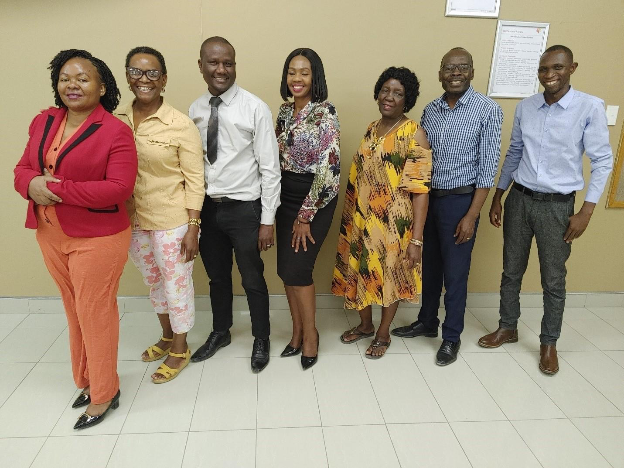
Meeting with the FUTE programme team at UNAM (HP Campus)
Inside UNAM HP Campus and Nature Insights
What struck us most was UNAM’s deep institutional dedication to sustainability. Classrooms here prioritize participatory learning, critical thinking, inclusivity, and strong community ties.
Standout courses we attended included:
- Teaching Pedagogies for Education for Sustainability (Undergraduate level)
- Gender Equality and Feminism in Science and Mathematics Education (Postgraduate level)
Through the FUTE project, we witnessed how local teaching practices deliberately align with global goals—especially SDG 4 (Quality Education) and SDG 5 (Gender Equality).
One highlight was our excursion to Etosha National Park via King Nehale’s gate. Walking through this iconic landscape gave us tangible lessons in biodiversity conservation, sustainable tourism, and the delicate balance between humans and nature—reinforcing why ESD matters so urgently.
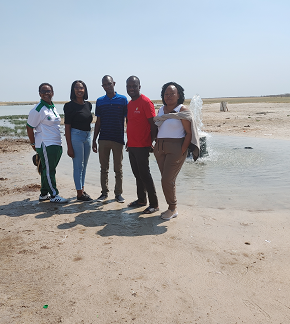
A visit to Etosha National Park through King Nehale’s gate
How the Exchange Deepened Our Own Research Journeys
Zephania Malongo: Sustainable Protein Sources for a Circular Food Future
My research— “Assessment of the Effect of Black Soldier Fly Larvae (BSFL) as a Protein Source in Chicken Feed”—explores affordable, eco-friendly alternatives to expensive conventional feeds.
Through an ESD perspective at UNAM:
- Cognitive gains: Deeper grasp of BSFL biology, nutrition, and sustainability value
- Social-emotional growth: Stronger collaboration, creativity, and sense of responsibility
- Behavioral impact: Promotion of circular economy practices and sustainable agriculture
The campus discussions and observations helped transform BSFL farming from a theoretical solution into a practical “change project” addressing feed costs while building resilient food systems.
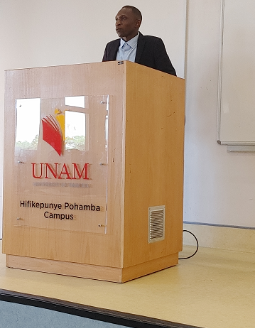
Mr. Zephania presenting proposal to UNAM staff & Students
Stella Mntambo: Ensuring Clean Water Access for Community Well-Being
My study— “Assessment of Quality and Accessibility of Drinking Water at Naitolia Village”—focuses on water security in rural settings.
The exchange enriched my work with:
- Practical insights into sustainable water management and long-term community health
- Hands-on exposure to water quality testing methods
- Community-centered research approaches
- Stronger theoretical framing through ESD principles
Interacting with UNAM scholars helped refine my methodology and heightened the study’s alignment with sustainability goals.
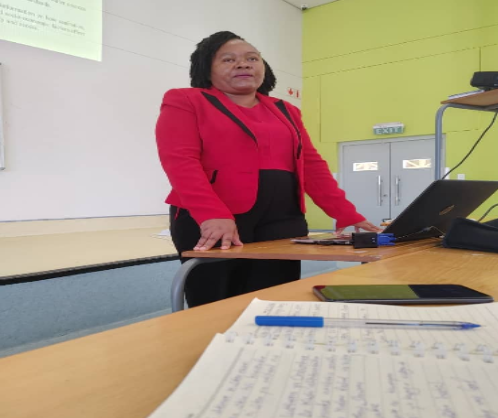
Ms. Stella presenting research findings to UNAM staffs & Students
Personal and Professional Growth: Skills That Will Last a Lifetime
Beyond research, the programme equipped us with sharper research, analysis, and academic presentation skills, greater confidence in cross-cultural teamwork and adaptability, and renewed appreciation for interdisciplinary, sustainability-driven inquiry. On a personal level, blending study, travel, and cultural exchange cultivated independence, patience, resilience, and a truly global mindset—qualities every sustainability educator and researcher needs. We extend deep gratitude to the funder for making this transformative opportunity possible.
Special thanks to the dedicated FUTE teams at DUCE and UNAM (HP Campus), and especially our supportive supervisors: Dr. Lucas Paul, Dr. Alice Isibika, Dr. Jared Bakuza, and Dr. Olivia John Kalokora.
We are also thankful to DUCE and the University of Dar es Salaam (UDSM) for enabling us to represent Tanzania on this international stage.
The FUTE Student Mobility Exchange was far more than an academic trip. It reshaped how we view sustainability, research collaboration, and the power of education to drive real impact. The lessons in sustainable food systems, gender-responsive pedagogy, and ESD will continue guiding our work. We return inspired, better equipped, and eager to contribute to a future where education truly serves people and the planet.
We invite readers, students, educators, researchers, to explore similar mobility opportunities. The connections we build today shape the sustainable tomorrow.