
Focusing on Foundational Skills – Nordic-Baltic PIAAC Conference in Jyväskylä
My autumn got off to an exciting start when I attended the Nordic-Baltic PIAAC Conference in Jyväskylä at the end of August. This two-day event was organized by the Nordic-Baltic PIAAC network and the Nordic Network for Lifelong Learning (NLL), with a focus on the Programme for the International Assessment of Adult Competencies (PIAAC). The conference brought together international participants from the fields of research and policymaking to explore the potential of the PIAAC data.
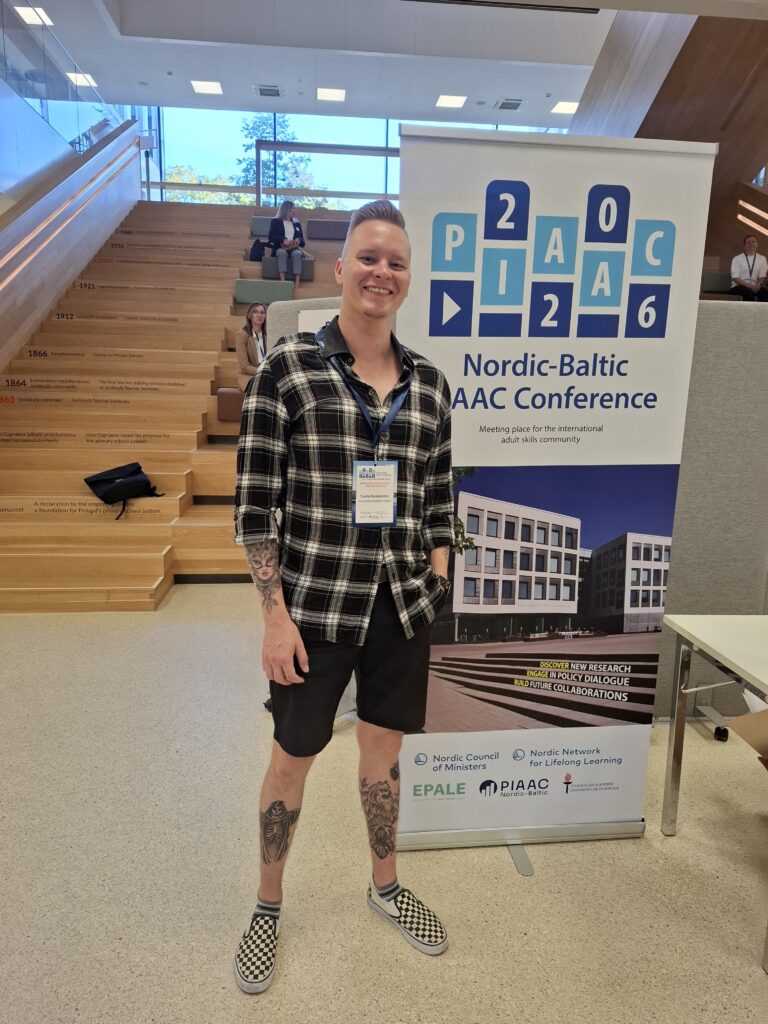
What is PIAAC, and what was I doing there?
Like the PISA studies, the PIAAC survey is organized by the OECD; it assesses the basic skills—specifically literacy, numeracy, and adaptive problem-solving—of the adult population aged 16 to 65. The survey has been conducted in two cycles (2011–2012 and 2022–2023), with data collected from over 30 countries, including Finland. In each country, the study gathers a large, representative dataset that provides insights into adults’ basic skills at the population level, while also includes comprehensive background information. It is, therefore, a unique study of skill levels that opens up numerous possibilities for various research approaches.
I attended the conference because the background data in the PIAAC dataset—which includes information on participants’ work and study histories—allows for the analysis of participants’ employment sectors and, consequently, any changes in their fields of work. I gave a presentation in Jyväskylä titled “Career change in Finland as field-of-study mismatch: utilizing Programme for the International Assessment of Adult Competencies (PIAAC) data.” I was by no means the only participant whose interest in the dataset focused on possibilities beyond adult basic skills; the background data includes information on socioeconomic status, demographic characteristics, and factors related to well-being, among others.
Attending conferences is a vital part of a researcher’s work: it offers a chance to present one’s research to an expert audience and provides opportunities to network and connect with colleagues from around the world. At the same time, I find the experience somewhat nerve-wracking, as the audience includes experts deeply versed in the subject matter, and imposter syndrome tends to rear its ugly head in such situations. Nevertheless, my conference experiences have ultimately been wonderful. For instance, on two occasions, I have referred in my presentation to a publication while one of its co-authors happened to be in the audience (one of these instances actually took place here in Jyväskylä), and the feedback has been nothing but positive. Although encouraging feedback on just a fifteen-minute presentation might seem like a small matter, it can play a significant role in shaping one’s identity as an emerging expert.
The Many Dimensions of the PIAAC Study – Key Themes Regarding Adult Learning and Participation
The concept of adult basic skills is so broad that the only apparent limit on research directions was the study’s own innovativeness; presentations covered topics such as the PIAAC methodology itself, working life and professional learning, labor markets, various demographic groups, learning within schools, and themes of well-being and inequality.
Several presentations also referred to the PISA study. This is hardly surprising, since the OECD conducts PISA studies as well, and PIAAC is often viewed as the adult version or counterpart to PISA. As with PISA, the ranking of countries based on scores is a point of interest in PIAAC. In broader media discussions, results may be oversimplified: they are presented primarily as an outcome of the education system, where the system “produces” skills and measuring them allows for a ranking of different systems. The reality is, of course, more complex; adult learning is influenced by many factors outside formal education, such as workplaces, social relationships etc..
Several recurring themes emerged from the presentations, speeches, and panel discussions during the conference. Even though Finland, for instance, ranks first in terms of scores across all basic skills measured by PIAAC, every country has a segment of the working-age population whose basic skills are at or below the low-proficiency level. This sparked discussion regarding issues such as well-being, learning opportunities, and societal participation. It felt meaningful to see firsthand how research data derived from extensive datasets such as PIAAC can support decision-making related to adult learning and social inclusion, even at the European level.
The Conference’s Contribution to My Research
Personally, the PIAAC conference was a positive and inspiring experience for me. The greatest benefit was realizing that, like myself, many other researchers focus their studies on aspects of the PIAAC dataset other than the measurement of basic skills. This reinforced my belief in the value of my research topic and the use of PIAAC data. Although I have certainly worked on my research topic with both my supervisor and colleagues, the conference allowed me to see concretely how it fits into a broader framework, making this an experience that was both motivating and encouraging.
As with any line of work, it surely takes time for conferences to feel routine, but I view the experience as a way to develop both my expertise and my identity as a researcher. For me, these remain unique occasions that bring variety and challenge to my independent work, and, fortunately, have so far provided inspiration and a sense of achievement as well.
From the Nordic-Baltic PIAAC Conference 2026 website, you can access and explore the abstracts of all presentations here: https://peda.net/nordicbalticpiaac2026
Tuomo Kuivalainen, PhD researcher