
Highlights from the NFF 2026 conference in Aarhus, Denmark
One of the strengths of our JATKOT research group has been its multidisciplinary nature. We each represent slightly different academic disciplines, with adult education serving as the unifying factor. These different perspectives enrich our group and ensure our focus remains broad. In this blog post, we take a journey into the world of business and economics and share experiences from the Nordic Academy of Management conference, which was held at the University of Aarhus in Denmark from 13th to 15th of August 2026. During a nice and warm week in August, we gathered to discuss and present topical and important issues.
The conference had various themes. Sustainability, climate and societal transformation were probably the largest overarching themes. Many tracks and presentations were also about how technology is changing organizations and society. My presentation of leadership supporting learning falled into the categories of leadership, HR, organisations and organisational life. Themes around governance, institutions, power and democracy included basically how organisations and societies are governed, whilst not overlooking situations of instability. In addition, themes such as uncertainty, crisis, resilience and global disruption were presented. Last but not least, presentations around themes of society, inclusion, inequality and identity were held.
Next, a few more specific highlights from individual presentations. Artificial intelligence was a topic in both the presentations and the keynote speeches, which was a good indication of how the world of research is linked to the wider world and current issues. One keynote address was delivered by an expert from the Centre for Hybrid Intelligence, whose aim is to develop collaboration between humans and artificial intelligence in an intelligent and multidisciplinary way, combining human expertise with AI to enable responsibility and creativity. According to the speaker, the impact of AI is greater than we realise and will unfold rapidly, but he highlighted how important it is to know how to navigate change. For example, redundancies as a pre-emptive measure (“AI is taking jobs”) are not a viable solution; rather, artificial intelligence should enhance human expertise rather than replace it. This is because there are scenarios associated with AI that are not necessarily true. He therefore advocated for intelligent action, citing the example of a major retail company which, rather than making redundancies, assessed what the AI-replaced customer service was unable to resolve, as well as the skills of its employees. It emerged that many had strong product knowledge, and this information, combined with the limitations of artificial intelligence, led to the creation of new roles in remote interior design consultancy. The speaker emphasised the benefits of AI across Europe.
The theme of AI continued in the presentations. The topic was addressed, for example, in a presentation that examined the use of AI by employees at the early stages of their careers. As a theoretical framework, they drew on Tynjälä’s theory of learning at work, which naturally delighted this alumnus of the University of Jyväskylä. Organisations often encourage the use of AI and learning about it, but whether guidance or training is sufficient, how AI is used and what one learns through it are valid questions. In one presentation, AI was, in turn, linked to learning. The aim of the research was to understand learning and the process that takes place simultaneously in humans and artificial intelligence – in other words, how the element of reciprocity should also be taken into account. Familiar learning theories are thus taking on a new lease of life in the face of the new challenges of today’s working life.
Learning was discussed in several presentations during the conference. Before my own presentation, we heard about organisational learning in relation to the changing objectives set by the organisation. It was interesting to hear about a different theory of organisational learning from the ones we have used ourselves. The presentation also highlighted the negative manifestations of learning.
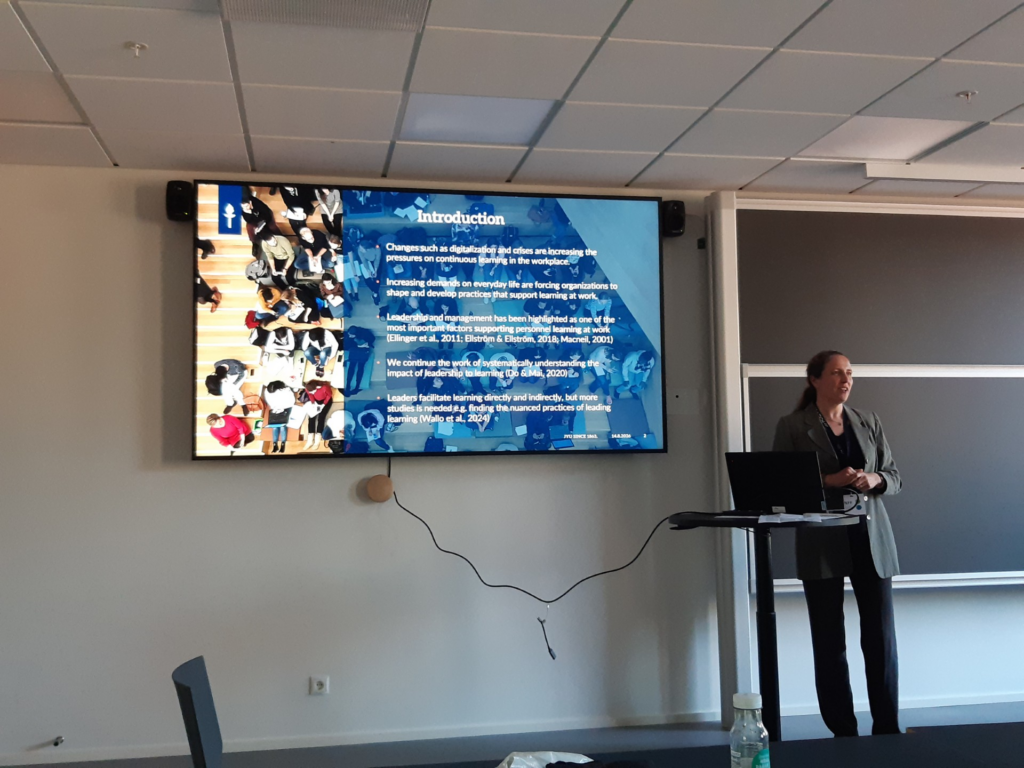
My own presentation was based on an article published just this summer, entitled “How can learning be supported at work? Systematic review of the strategic and emergent practices of learning-supportive leadership” (Jaakkola, Lemmetty & Collin, 2026), which was published in International Journal of Training and Development. Leadership has been identified in previous literature as an important factor in promoting learning at work, and the aim of our research was to deepen this understanding. We examined practices through which leadership can support and promote employees’ learning at work. The presentation sparked an interesting discussion on, amongst other things, the negative manifestations of learning – it was intriguing that our analysis hardly picked up on these at all. This can probably be explained by the fact that the emphasis was on identifying different support practices. The discussion continued on how learning can, however, be both a source of wellbeing at work and a burden (see Collin, Jaakkola, Keronen & Lemmetty 2024).
Denmark and Aarhus showed themselves at their best as the sun shone warmly, whilst we met friendly and pleasant people, chefs conjured up delicious dishes, and admiring beautiful scenery, for example, whilst looking out of the train window. The city was beautiful, and it was fascinating to observe the seamless coexistence of new and old buildings in the architecture. The university’s new building had only just been completed, so we were effectively among its first users. We were able to enjoy a very well-organised conference.
Attending conferences holds many benefits for a researcher. One’s own presentation may not always attract many comments – perhaps due to a small number of attendees – but speaking about one’s own topic, presenting arguments and justifying research choices in itself helps to develop one’s professional skills as a researcher. Furthermore, whilst writing is a fundamental tool in our work, verbal expression provides a welcome change of pace. Drawing inspiration from others’ research is also part of what conferences have to offer, not to mention discovering new concepts or new combinations of familiar ones. Networking is another benefit of conferences, and NFF 2026 offered a particular opportunity to strengthen Nordic cooperation. The next NFF 2028 conference, held every other year, will take place in the town of Lillehammer in Norway.
PhD student Marianne Jaakkola
Jaakkola, M., Lemmetty, S., & Collin, K. (2026). How Can Learning Be Supported at Work? Systematic Review of the Strategic and Emergent Practices of Learning Supportive Leadership. International Journal of Training and Development.
Link to the publication: https://onlinelibrary.wiley.com/doi/pdf/10.1111/ijtd.70036
Collin, K. M., Jaakkola, M., Keronen, S., & Lemmetty, S. (2025). Sustainability of learning at work: experiences of police, hospital, and ICT personnel. Studies in Continuing Education, 47(1), 174–192.