
Invited lectures and workshops – making research accessible, disseminating results and building new collaborations
The past couple of years in the JATKOT group have involved not only active research but also the dissemination of research knowledge. The most typical way to spread research findings – in the university context – is naturally through teaching. The traditional idea in universities has been, and still is, that researchers also teach and teachers also do research. This ensures that university teaching remains on par with the latest research. However, the core mission of universities in terms of societal interaction also requires stepping outside the organisation with research results. But what does that actually mean in a researcher’s everyday work?
Traditional and Social Media
When a research publication is finally released – often after a process lasting months, sometimes years – in a scientific journal or book, it typically results in a press release. This is especially the case when the findings are seen as highly valuable in the present moment or reveal something new that is assumed to interest and matter to a wider audience. However, only a small portion of press releases ever make it through to mainstream media. The experience in the JATKOT group has been that research results, which often do not provide direct answers or instructions, rarely turn into flashy and media-sexy press releases. This is because researchers, for good reasons – including ethical ones – cannot always interpret or reshape even highly significant results into forms that interest the general public or journalists. The press release as a text genre is often unfamiliar to researchers, and its quality is not ranked very high on the list of priorities. Since press releases tend to be “all or nothing” communication (meaning that if the mainstream media takes interest, they can reach a massive audience, but if the journalist is not intrigued, the release barely reaches anyone), the trends of the modern world have led research to diversify its communication significantly.
Social media offers researchers a channel to popularise their work, attract followers interested in the topic, and build networks with others in the same field or career stage. At its best, social media communication is systematic and integrated into daily work, with a lower publication threshold and more everyday topics than the one-off press releases focused on new results. Although social media also poses risks for researchers – from being targeted by harassment to receiving mocking comments – it provides a valuable context for research communication.
“We have tried to keep our social media as an easy shop window into researchers’ everyday lives, without flaunting difficult concepts or complex theories unnecessarily. Their use is, of course, reserved for other aspects of research work.”
The JATKOT group’s social media activity has been focused on Instagram, where over the past couple of years the group has introduced its members and their research topics, shared stories from conferences and everyday research life, and highlighted information about new publications. The aim has been to keep the social media feed approachable for visitors – a window into researchers’ everyday work, without needless showing off with complicated jargon. Social media communication is also linked to the group’s Jatkoilla blog, with new posts promoted through social media channels. The blog, however, is a form of communication that requires more time and interest from its followers. It is more strongly targeted at those who want to delve deeper into the topics that appear only in passing in social media posts.
Speaking Engagements and Expert Talks
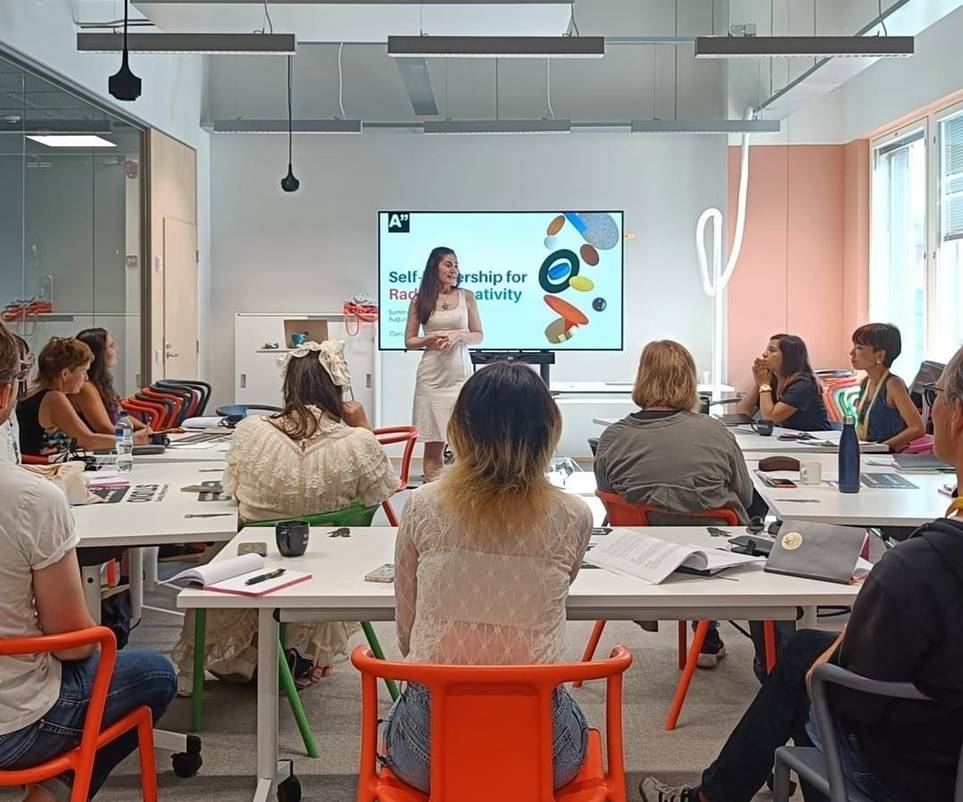
Alongside written and visual communication, another key avenue for popularising research and engaging in societal interaction is oral communication. The expertise of the JATKOT group in continuous learning, adult competencies, workplace well-being, as well as innovation and leadership has been recognised nationally and regionally. Our group has specialist knowledge on many of the themes in working life and adult learning that are now considered timely in organisations and society. This allows us to offer expert lectures for a wide range of needs. During the past academic year, our researchers, have been designing lectures and workshops, talks, and panel discussions – sometimes at quite a rapid pace. Lectures and workshops have been delivered in educational institutions, wellbeing service counties, and various organisations. Participation in events and webinars organised by the Ministry of Education and Culture as well as the Ministry of Economic Affairs and Employment has also proven to be excellent opportunities to disseminate the knowledge produced by the group.
In addition to individual lectures, group members have at times – for an additional fee, as “evening and weekend jobs” – agreed to deliver broader workshop and training packages. These have been implemented both as online training packages and live trainings, for example for education providers and municipalities. Training packages and workshops demand more planning work and naturally take more time.
Not Just Copy-Pasting onto PowerPoint
Trainings and lectures are not just about transferring research findings onto PowerPoint slides. They are about researchers examining their own work as a whole, answering the question: “what does my research offer on the topic the client has requested?” They are useful for researchers because they require looking at one’s research from a new context, adapted for a new audience. In my experience, designing lectures and trainings has developed my research expertise, strengthened my understanding of the diversity – but also the boundaries – of my own research area. Preparing training and lecture materials on one’s own topic is therefore already a learning process in itself. This process continues in the actual lecture, as participants always bring something new to the situation. In medical education, the lecturer learns about hospital routines; in technology workshops, about innovation pressures; in education conferences, about the everyday life of teachers.
All this provides stimuli for directing research, choosing target groups, and assessing impact of the research. It also enables networking: one lecture leads to another and then another, until you find yourself in the middle of a wide network of actors from different fields who are interested in research knowledge. This network can be invaluable when planning new research projects and their partnerships.
Although there is increasing talk about research impact and communication – and the idea of researchers confined to ivory towers is rapidly becoming outdated – the foundation of all the buzz and discussion is still systematic, high-quality science. Topics and perspectives in communication will quickly run out if time for conducting research itself is not secured. There is much demand for researchers in expert roles across different areas of society. It is important to know how to say no – or at least not now – in order to ensure that in the future, there will still be something to share with the public.
Soila Lemmetty, JATKOT Research Group